





Shifting Dynamics and Emerging Openings for Peace in the Middle East
Shifts in US strategy, the erosion of Iran’s regional power, and the Gulf’s growing economic momentum may collectively create new opportunities for stability in the Middle East
For several decades, peace in the Middle East has seemed like a pipe dream. The region has become associated with seemingly endless conflict. Throughout its modern history, the Middle East has experienced moments of hope, but these have often been overtaken by new cycles of violence. For many, both inside and outside the region, the de facto status quo has been one of instability.
Despite ongoing conflicts in Libya, Yemen, and elsewhere, as well as the spillover effects of the US–Israel standoff with Iran, the Middle East today has three main factors that could alter this bleak trajectory and pave the way for a breakthrough: the strategic role of the United States (US); the diminishing regional influence of Iran; and increasing economic prospects in the Gulf.
The strategic role of the US in supporting peace prospects
One of the fundamental shifts in the international relations of the Middle East is the US’s role under Donald Trump’s presidency. Trump’s return to the White House was initially widely seen as ushering in an era of American isolationism, with America First regarded by many observers as signalling that the US would pay less attention to the Middle East. However, the Trump administration has taken a markedly different path. Hamas’s attack on Israel on 7 October 2023 underlined that the status quo in the region, with which both the US and Israel had been living uncomfortably, was no longer acceptable, as it posed an existential threat to Israel and ran counter to American interests. The start of Trump’s second presidency coincided with this moment of reckoning.
Trump’s return to the White House was initially widely seen as ushering in an era of American isolationism, with America First regarded by many observers as signalling that the US would pay less attention to the Middle East.
The Trump 2.0 era has been marked by a highly engaged American foreign policy aimed at ending conflicts and strengthening partnerships in the Middle East. The US has played a seminal role in the Gaza ceasefire and in plans to stabilise Gaza, as well as in efforts to enable the Lebanese state to assert a monopoly over weapons in the country. The US has also strongly embraced the new government of President Ahmed al-Sharaa in Syria, viewing the post-Assad era as an opportunity to counter threats to stability in the Levant posed by both Daesh and Iran-backed factions. The US’s addition of Syria to the Global Coalition Against Daesh is an important step in this regard.
Prospects for countering Iranian destabilisation and the Israel–Palestine conflict
The US has shown little hesitation in intervening militarily against Iran, targeting Iran-backed militias such as the Houthis, and openly supporting Israel’s strikes against Iran and its proxies in Syria, Lebanon, Yemen, and Iraq. This marks a significant shift not only from the administration of Joe Biden but also from Trump’s first term. During that period, Trump withdrew the US from the nuclear agreement with Tehran, reimposed sanctions on Iran, and authorised the killing of General Qassem Suleimani, the leader of Iran’s elite Quds Force and the architect of its network of regional influence. Today, the US has signalled that its objective is not merely to contain the Iranian threat but to eliminate it.
The US shift on Iran has brought Washington closer to the strategic outlook of Gulf Arab states. Saudi Arabia and the United Arab Emirates had for years warned of Iran’s destabilising actions in the region, but their concerns received lukewarm responses from Washington during the administrations of Barack Obama and Joe Biden. Despite bearing the brunt of Iranian retaliation following the 28 February 2026 US–Israeli attack on Iran, Gulf Arab states may ultimately be able to pursue their ambitious national development programmes with reduced concern about threats from Iran or its proxies. This outcome, however, will take time to materialise as the scale of the US–Israel war with Iran expands. In the longer term, the strategic shift in US policy towards the Middle East could represent a concrete step in a more favourable direction for the Gulf and the wider region, as Iran becomes increasingly isolated and constrained in its ability to recover from its losses.
Arab states, led by Saudi Arabia, remain committed to the 2002 Arab Peace Initiative, which links normalisation with Israel to the establishment of a Palestinian state.
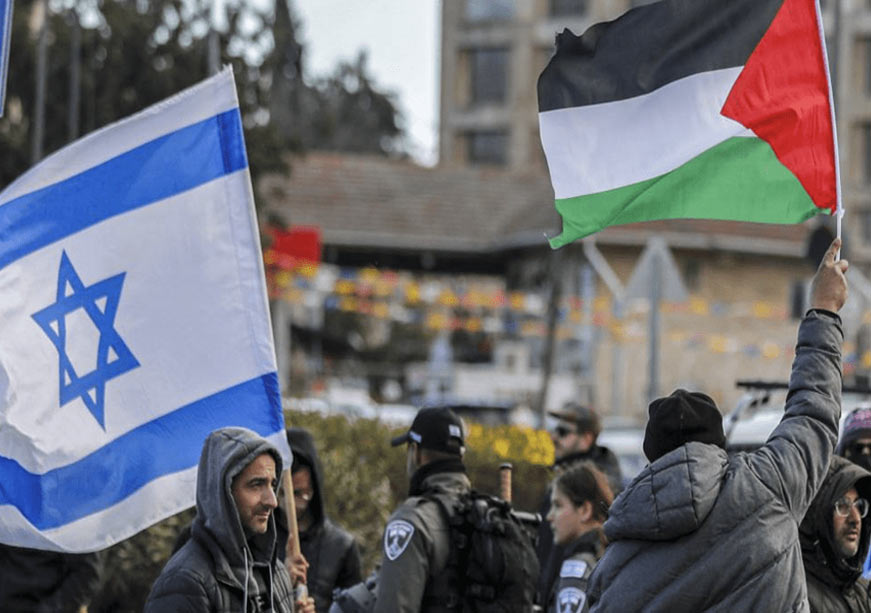
It is widely acknowledged that lasting peace in the Middle East cannot be achieved without resolving the Israel–Palestine conflict. Iran has instrumentalised the conflict to advance its regional ambitions, branding its network of proxies as the so-called “axis of resistance” against Israel and the US to cloak destabilising actions in a veneer of legitimacy. With Iran and its proxies weakened by Israeli and American military action, prospects for addressing this decades-old conflict may improve. Arab states, led by Saudi Arabia, remain committed to the 2002 Arab Peace Initiative, which links normalisation with Israel to the establishment of a Palestinian state. There is growing Arab momentum towards normalisation with Israel, supported by US diplomatic efforts. Israel may seek to capitalise on this moment to pursue a durable peace with its neighbours.
Prospects for economic prosperity
Peace is not solely about politics and security. Without economic prosperity, countries risk confronting grievances that can fuel instability. The Middle East today has an opportunity to turn a page economically. The US remains committed to multiple bilateral economic partnerships with Middle Eastern countries, a commitment reflected in its new National Security Strategy. The strategy states that: “The days in which the Middle East dominated American foreign policy in both long-term planning and day-to-day execution are thankfully over—not because the Middle East no longer matters, but because it is no longer the constant irritant, and potential source of imminent catastrophe, that it once was. It is rather emerging as a place of partnership, friendship, and investment.”
Lebanon’s stated interest in joining this initiative is an indicator of how countries previously aligned with Iran’s regional orbit are reassessing their economic futures.
Economic success in major countries such as Saudi Arabia could have a cascading positive impact on the wider region. This would bolster opportunities for reconstruction and development in Gaza, Lebanon, and Syria, among others, and open additional investment and trade routes across the region. Initiatives such as the India–Middle East–Europe Economic Corridor play a key role in this evolving landscape, strengthening the region’s position as an economic bridge between Asia and Europe. Lebanon’s stated interest in joining this initiative is an indicator of how countries previously aligned with Iran’s regional orbit are reassessing their economic futures. Economic partnerships may, in turn, have a stabilising effect on security, as countries with shared economic interests are likely to seek to protect them.
Peace in the Middle East has long been elusive. Although the path towards peace is unlikely to be straightforward and will remain vulnerable to setbacks—with the current situation in Iran posing a significant challenge—the broader outlook for this strategic region is cautiously hopeful. However, this hope depends on regional actors and their international partners seizing existing opportunities to chart a mutually beneficial future.
Lina Khatib is an Associate Fellow in the Middle East and North Africa Programme at Chatham House and a Visiting Scholar at the Harvard Kennedy School’s Middle East Initiative.