






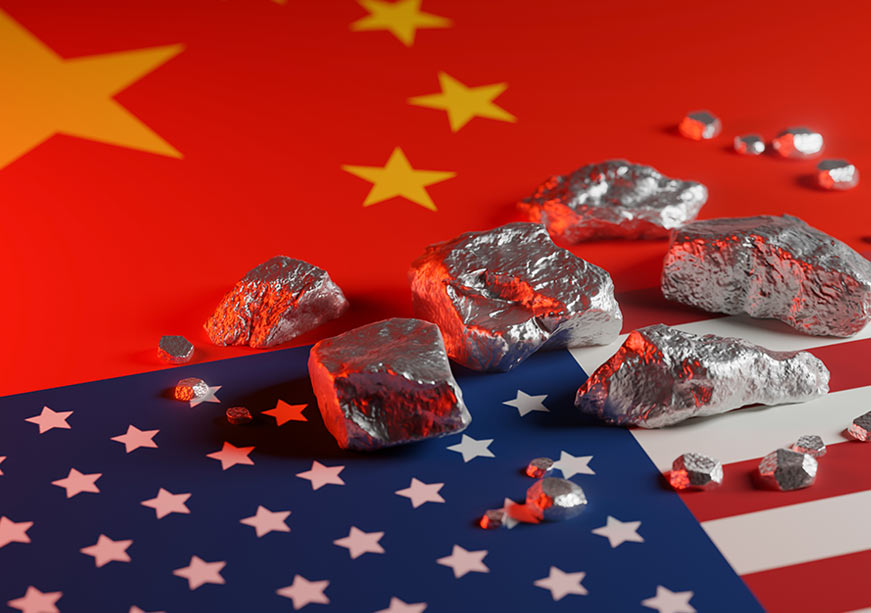
Rare Earth Elements at the Forefront of Strategic Competition
REEs have become a central arena of US–China strategic rivalry, with China’s dominance across the full production cycle giving it powerful economic and military leverage against the US
The strategic importance of rare earth elements (REE) stems from their key role in the green transition and the deployment of renewable energy technologies. Thorium, which is extracted from REE ores, promises to replace uranium in the future as the basis for nuclear fuel production, given its greater availability and more environmentally friendly characteristics. One tonne of thorium can produce as much energy as 200 tonnes of uranium or 3.5 million tonnes of coal.
In 2025, the REE market volume exceeded 7.2 billion dollars, and in 2026, it is projected to reach 7.6 billion dollars. By 2035, it is estimated to reach 12.6 billion per year, increasing by 6 percent on average. While these figures may appear modest in absolute terms, access to rare earths is critically important for developing modern technologies and ensuring national security.
Global reserves of REE ores are quite large, including in the Arctic; however, the main problem lies in acquiring the technologies required for processing and production. Having invested in the development of the critical minerals in the early 1990s, China now occupies a leading global position.
Thorium, which is extracted from REE ores, promises to replace uranium in the future as the basis for nuclear fuel production, given its greater availability and more environmentally friendly characteristics.
First, China extracts 60 percent of the raw materials and controls between 60 and 80 percent (depending on the metal) of the REE market. This allows China to supply 94 percent of permanent magnets to the global market, which are used for the production of semiconductors, cars, industrial engines, data centres, jet aircraft, and weapons systems.
China has sought to strengthen its position by imposing export controls on strategically important minerals through measures such as the Export Control Act of 2020. It uses quotas to limit the production of rare earths to regulate the global market. At the same time, Beijing is diversifying its mineral imports and investing in countries with significant resource concentrations.
Second, China remains the only country with a complete REE production cycle, enabling it to exert control over global supply chains involving rare earths and related technologies. In April 2025, China restricted exports to the United States (US) of seven REEs (scandium, yttrium, samarium, gadolinium, terbium, dysprosium, lutetium) along with related components. In October 2025, additional restrictions were imposed on the export of technologies and equipment. Regardless of where final products are manufactured, foreign companies are required to obtain a permit in China if they use Chinese REEs, derived components, technologies, or equipment.
This dominant position allows China to regulate prices on the global market and leverage it in economic competition with the US. For example, in response to American sanctions on semiconductor supplies, China banned exports of gallium and other semiconductor-related materials to the United States in December 2024. According to expert estimates, US high-tech industrial production is 70 percent dependent on Chinese REE exports, which means that a sharp reduction in supplies creates serious difficulties for leading chip manufacturers like AMD, Apple, Broadcom, and Nvidia, among others.
US high-tech industrial production is 70 percent dependent on Chinese REE exports, which means that a sharp reduction in supplies creates serious difficulties for leading chip manufacturers like AMD, Apple, Broadcom, and Nvidia, among others.
The Trump administration is irked by China’s leadership position in this sector. In 2024, the US imported about 80 percent of REEs required to meet domestic demand. Given its limited domestic reserves, Washington has shown growing interest in deposits abroad, including in Canada (830 thousand tonnes) and Greenland (1,500 thousand tonnes), which explains the particular attention to the latter. Trump’s policy towards Greenland reflects concerns that, in the absence of sufficient Western investment, Greenland may turn to alternative partners, including China. Strategic rivalry over Greenland is aggravated by the presence of the Chinese company Shenghe Resources, which is involved in developing the important Kvanefjeld deposit. Control over Greenland would completely solve the problem of ore and simultaneously make it possible to displace China.
Mutually beneficial cooperation with Russia (3,800 thousand tonnes of REE ore) is also a possible avenue, if relations can be normalised. Russia has announced ambitious plans to develop its own full-cycle REE production technologies. Russia is an attractive destination for the US because the Tomtroskoye deposit, located in the Arctic zone of the Russian Federation, has the highest ore concentration in the world at 14.5 percent.
In addition to mining ore, the US also needs investment for the development of its own full-cycle REE production capabilities. Experts estimate that such technologies and industrial facilities could be established by 2035; however, they would meet only about 25 percent of demand. Thus, it will take years to eliminate dependence on China, even with the expansion of the raw material base. Meanwhile, any disruption to REE supplies would affect the production of advanced weapons systems — including the F-35 fighter jet, Arleigh Burke-class destroyers, and Virginia-class submarines — since 77.7 percent of them incorporate REEs. The development of satellite systems and hypersonic weapons will also slow down. There are about 2,500 tonnes of key REE in the US strategic reserve, sufficient for only six months of critical defence operations.
There are about 2,500 tonnes of key REE in the US strategic reserve, sufficient for only six months of critical defence operations.
Therefore, American experts propose establishing an international coalition to support long-term investment in full-cycle REE production. The main American partners are the EU (SecREEts project) and Australia (Lynas Corporation), but the US is also roping in Japan and Saudi Arabia to counterbalance China’s dominance. Western European countries may access raw materials from Scandinavia, but Europe remains reluctant to confront China directly or assume the financial and environmental risks associated with large-scale rare earth extraction and processing on its own territory.
China turned out to be the only state able to challenge the United States because of the unilateral economic sanctions imposed. It was after the introduction of restrictions on rare earth exports that Trump was forced to soften his position on sanctions against China. Clearly, control over REEs has become one of the main components of the rivalry between the United States and China in the Arctic, and China is likely to gain the upper hand in the foreseeable future.
Valery Konyshev is Professor of International Relations, Russian Academy of National Economy and Public Administration.