

A Vision of Water Governance for Viksit Bharat@2047: Markets, Institutions, and Imperatives
Attribution: Nilanjan Ghosh and Ambar Kumar Ghosh, Eds., A Vision of Water Governance for Viksit Bharat@2047: Markets, Institutions, and Imperatives, Observer Research Foundation, March 2026.
1: Introduction
Water inherently transcends multiple boundaries. Water governance, therefore, is a complex,[a] “transboundary” challenge. The first source of complexity emanates from “hydrological transboundariness”: rivers, aquifers, and watersheds cut across villages, cities, states, and countries, linking surface water and groundwater systems. In the process, decisions taken upstream, and their consequences—such as dams, diversions, or pollution—directly affect downstream users, creating spillovers and externalities that governance systems struggle to internalise. A second source of complexity concerns the allocation of water across competing users and sectors—agriculture, urban areas, industry, and ecosystems—each with different priorities, scales, and reliability needs. This implies another form of “transboundariness”, as water effectively “crosses” sectoral boundaries.
A third source lies in the artificial boundaries created for governing water, in the form of fragmented institutions with overlapping mandates, often reinforced by power asymmetries that privilege some users while marginalising others. This fragmentation promotes a disjointed approach to governance rather than the integrated management required for a flow regime. A fourth source originates from the exogenous force of climate change, which introduces deep uncertainty through greater variability, floods, and droughts, undermining governance frameworks built for stable conditions. A fifth source of complexity arises from persistent trade-offs among efficiency, equity, and ecological sustainability, making water governance a political and normative challenge rather than a purely technical one.
While traditional geopolitical approaches restrict the idea of transboundary waters to those crossing international borders, more recent interpretations expand the notion of “transboundariness” to encompass all forms of boundaries—from international and inter-state divisions to smaller social and sectoral demarcations.[i] This broader understanding also includes inter-state water systems within a single nation. Importantly, a new dimension of transboundary water conflict has emerged between the economic and ecological domains.[ii] Human activities motivated by short-term economic interests frequently alter natural flow patterns, leading to severe ecological degradation downstream.
Although river basins are widely acknowledged as the most suitable natural units for planning and managing surface water resources,[iii] governance structures have historically fragmented them into smaller administrative or political segments, often in an arbitrary manner. This fragmentation stems from two main factors: the managerial convenience it offers, and adherence to existing political or geographical boundaries.[iv] Such an approach reflects a reductionist perspective that treats water merely as a resource to be exploited to meet human needs within defined territories.[v] This approach has shaped—and adversely impacted— the water governance architecture in India. Recurring water disputes between Indian states, and between state and central authorities, largely arise from this reductionist thinking and the decentralised governance model embedded in India’s federal framework.[vi]
India has 25 major river basins and 103 sub-basins spanning multiple states; many of these river basins and sub-basins cross state boundaries. Under the federal division of powers established by the Constitution of India, each riparian state asserts jurisdiction over water resources within its boundaries.[vii] However, disputes over water allocation arise less from physical scarcity and more from fragmented governance that fails to reflect the interconnected nature of river systems.[viii] The unstructured devolution of water management authority to the states has intensified political conflicts, driven largely by divergent interpretations of ownership and rights over shared water bodies.[ix] This fragmented approach is closely tied to India’s long-standing reliance on structural interventions and reductionist governance models, which have shaped the nation’s water management paradigm—from large hydrological infrastructure and irrigation networks linked to food security to the inter-state disputes over shared water resources.
It is also important to note the growing water scarcity in India. Under the Falkenmark Water Barrier Scale definitions (Table 1), physical water availability is classified into five categories based on per capita availability, measured as the number of persons per flow unit of water (defined as one million cubic metres per year).
Table 1: Falkenmark Water Barrier Scale
| Description as per Falkenmark Water Barrier Scale | Flow Unit Classification | Per capita Water availability (cubic metres per capita) |
| Well-Watered Conditions | <100 persons/flow unit | >10,000 |
| Mid-European | 100-600 persons/flow unit | <10,000 and >= 1,700 |
| Water stressed | 600-1,000 persons/flow unit | <1,700 and >=1,000 |
| Chronic Scarcity | 1,000-2,000 persons/flow unit | <1,000 and >= 500 |
| Beyond the Water Barrier | >2,000 persons/ flow unit | <500 |
Sources: Jobson (1999),[x] Ghosh (2009)[xi]
Given the classifications in Table 1, Table 2 provides the state of the major river basins of India in 2025, and their projected status in 2050.
Table 2: Water Availability in Select Indian River Basins, 2025 and 2050 (Falkenmark Scale)
| River Basin | Population per flow unit in 2025 | Classification as per the Falkenmark Index in 2025 | Population per flow unit in 2050 | Classification as per the Falkenmark Index in 2050 |
| Indus (up to Border) | 1,520 | Chronic Scarcity | 1,788 | Chronic Scarcity |
| Ganga | 1,164 | Chronic Scarcity | 1,369 | Chronic Scarcity |
| Brahmaputra | 91 | Well-watered | 107 | Mid-European |
| Barak & Others | 118 | Mid-European | 139 | Mid-European |
| Godavari | 757 | Water-stressed | 891 | Water-stressed |
| Krishna | 1,128 | Chronic Scarcity | 1,327 | Chronic Scarcity |
| Cauvery | 1,749 | Chronic Scarcity | 2,057 | Beyond Water Barrier Scale |
| Subarnarekha | 1,031 | Chronic Scarcity | 1,213 | Chronic Scarcity |
| Brahmani & Baitarani | 458 | Mid-European | 539 | Mid-European |
| Mahanadi | 602 | Water-stressed | 708 | Water-stressed |
| Pennar | 1,454 | Chronic Scarcity | 1,711 | Chronic Scarcity |
| Mahi | 1,159 | Chronic Scarcity | 1,364 | Chronic Scarcity |
| Sabarmati | 1,338 | Chronic Scarcity | 1,574 | Chronic Scarcity |
| Narmada | 417 | Mid-European | 491 | Mid-European |
| Tapi | 931 | Water-stressed | 1,096 | Chronic Scarcity |
| West Flowing Rivers (Tapi to Tadri) | 360 | Mid-European | 424 | Mid-European |
| West Flowing Rivers (Tadri to Kanyakumari) | 452 | Mid-European | 532 | Mid-European |
| East Flowing Rivers (Mahanadi to Pennar) | 1,476 | Chronic Scarcity | 1,736 | Chronic Scarcity |
| East Flowing Rivers (Pennar to Kanyakumari) | 2,779 | Beyond Water Barrier Scale | 3,270 | Beyond Water Barrier Scale |
| West Flowing Rivers of Kutch & Saurashtra incl. Luni | 1,355 | Chronic Scarcity | 1,595 | Chronic Scarcity |
| Minor rivers draining into Myanmar (Burma) & Bangladesh | 80 | Well-watered | 93 | Well-watered |
Source: Estimated by the authors using data from DMEO’s “Water Resources” Sector Report.[xii]
Table 2 shows that, across the selected river basins, per capita availability of water (reciprocal of the number of persons per flow unit of water) will only decrease over time. Indeed, water stress in India has increased over the years in terms of declining per capita availability (largely due to population growth), from over 1,800 m3 in 2001 to around 1,545 m³ (2011) to about 1,486 m³ (2021 projected based on estimated population data), and finally projected at 1,367 m³ (2031), placing the country in a state of water stress (below 1,700 m³) and nearing chronic scarcity (below 1,000 m³) in many regions, with projections showing demand exceeding supply significantly by 2025.[xiii] The projected situation across the river basins presents a sobering picture: with a declining per capita availability, more river basins are moving towards higher levels of scarcity classification by 2050 (Figure 1). Yet, scarcity is only one dimension of the challenge—the complexity is heightened if one considers that water is used by life beyond humans, on which the human society and its existence are reliant.
Figure 1: Classifications of Indian River Basins as Per Falkenmark Index in 2025 and 2050
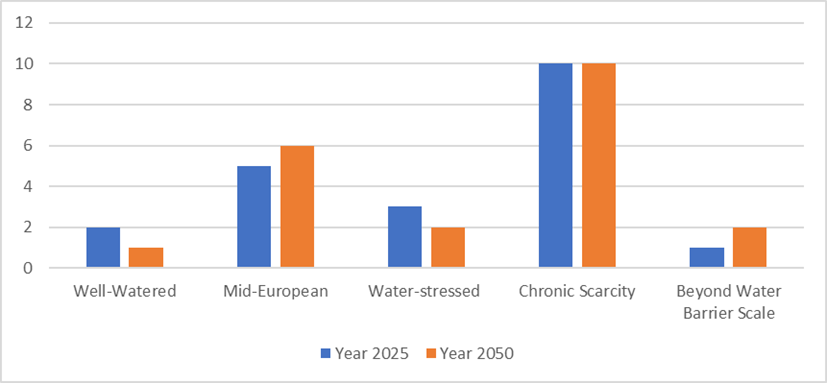
Source: Estimated by authors, using the Falkenmark indicator definition in Table 1 and the DMEO data in Table 2.
- India’s Water Policy Landscape
Since the early 1990s, the global water governance landscape has steadily shifted away from its old, reductionist, siloed models anchored in hard infrastructure toward a more nuanced, evolving paradigm of Integrated Water Resource Management (IWRM).[xiv] This transition is also reshaping the Indian thinking on hydrological projects—redefining irrigation systems central to food security and recalibrating approaches to managing inter-state rivers, urban and drinking water needs, and basin-scale ecological concerns.
For decades, the legacy of British colonial engineering and a fragmented approach to water management dominated India’s water governance paradigm. In recent years, however, a perceptible shift away from such reductionism has emerged. There has been greater contemplation about embracing an integrated, river-basin-scale approach to governance grounded in long-term sustainability concerns. India’s National Water Policy (NWP) of 2012, which remains in force, and a handful of other governmental reports over the last decade, have emphasised the need for an integrated water management architecture—an approach reinforced through subsequent governmental efforts focused on water security.
These documents not only emphasised the need for a paradigm shift in water governance but also highlighted the requirement for new institutional mechanisms.[xv] However, gaps remain in translating these ideas into action—whether in rethinking the water–food linkage beyond traditional assumptions or in embedding ecosystem considerations into river basin governance. Further, though most of these documents tacitly or explicitly subscribe to the Dublin Principles of IWRM (1992),[b] including the notion of water as an economic good, there is limited acceptance or understanding of the economic value of water or of the importance of water markets for efficient and equitable water allocation within civil society and water managers. Globally, water markets and market-based instruments have been envisaged to play important roles in efficient water management, especially under conditions of water scarcity.
Taken together, the multiple dimensions of transboundariness—hydrological, sectoral, and institutional—point to a deeper structural challenge: India’s water stress is not merely a function of physical scarcity but of a governance architecture that fragments a single socio-ecological system into disconnected administrative, economic, and political domains. This fragmentation weakens institutional capacity to anticipate risk, manage trade-offs, and align incentives across scales. The challenge, therefore, is not simply to secure more water but to redesign the rules, institutions, and instruments through which water is valued, allocated, and governed. It is within this broader systems perspective that this report situates its central enquiry.
‘Viksit Bharat@2047’ presents a holistic developmental vision for India, envisaging the country as a developed nation by 2047 through an emphasis on ‘Sustainable Energy Solutions’ and ‘Inclusive Governance Practices’.[xvi] The Viksit Bharat blueprint is not only about achieving per capita Gross Domestic Product (GDP) growth but also about equity and distributive justice while addressing sustainability concerns. Therefore, the focus on water security and climate resilience in the context of Viksit Bharat should entail a holistic approach for addressing complex challenges of environmental sustainability and food security, acknowledging and ensuring the changing and diverse uses of water by securing the needs of the human community, and ensuring economic growth under conditions of growing water scarcity and changing hydrological cyclicity caused by climate change.
Keeping these considerations in view, this report addresses the following questions:
1) What should be the tenets of a National Water Vision for Viksit Bharat?
2) What institutional structures and instruments are needed to achieve this vision?
3) How can the private sector, including the corporate actors, contribute to this vision?
4) What roles can water markets and market-based instruments play?
To answer these questions, the report develops a futuristic vision of an integrated water governance architecture for India, to be realised through structural reforms in institutional mechanisms and the governance paradigm of a multi-layered management framework. Section 2 examines changing paradigms in global water governance and situates the Indian case within this broader transition. Section 3 assesses the institutional, governance, and procedural challenges that shape India’s multi-dimensional water governance architecture. Section 4 discusses imperatives for institutional reform, with particular attention to inter-state water governance. Section 5 explores the role of the private and corporate sectors in advancing market mechanisms such as water credits and water derivatives trading, alongside the broader role of water markets and institutions in enabling efficient, integrated, and sustainable water governance. Section 6 highlights the key tenets of India’s National Water Vision and proposes a template for strengthening the water governance architecture in tune with the Viksit Bharat blueprint. Section 7 concludes with reflections on the need for a more robust water governance architecture.
It is crucial to underline that this report confines itself to the water governance vision of 2047 by setting a systems frame for norms, governance architecture, role of markets, and basin federalism. This report has not tested the implementability of the architectural tenets, an aspect that should be the subject of future research in this domain.
Nilanjan Ghosh is Vice President, Development Studies and Kolkata Chapter, ORF.
Ambar Kumar Ghosh is Associate Fellow, Governance Development Studies, ORF.
All views expressed in this publication are solely those of the authors, and do not represent the Observer Research Foundation, either in its entirety or its officials and personnel.
Endnotes
[a] “Complex problems” refer to challenges that cannot be understood, solved, or managed through linear, single-discipline, or purely technocratic approaches. This is because of multiple interacting systems, non-linearity and feedback loops, uncertainty, context dependence, multiple stakeholders, and path dependency and irreversibility.
[b] The Dublin Principles, established at the 1992 International Conference on Water and the Environment, emphasises four key ideas: water is a finite, vulnerable resource; management requires a participatory approach with users, planners, and policymakers; women play a central role in water management; and water has economic value in all its uses and should be recognised as an economic good, while also being a basic human right. These principles guide holistic water management for sustainable development, striking a balance between human needs and environmental protection.
[i] Heather. L. Beach et al., Transboundary Freshwater Dispute Resolution: Theory, Practice, and Annotated References (New York: United Nations University Press, 2000).
[ii] Nilanjan Ghosh, “Challenges to Environmental Security in the Context of India–Bangladesh Transboundary Water Relations,” Decision 42, no. 2 (April 28, 2015): 211–28, https://doi.org/10.1007/s40622-015-0082-4.
[iii] E. H. Lloyd, “Book Review,” review of Design of Water-Resource Systems: New Techniques for Relating Economic Objectives, Engineering Analysis, and Government Planning, by Arthur Maass, Journal of the Royal Statistical Society, Series A (General) 126, no. 3 (1963): 480, https://doi.org/10.2307/2982245.
[iv] Chuck Howe, “The Return to the River Basin: The Increasing Costs of ‘Jurisdictional Externalities’,” Journal of Contemporary Water Research & Education 131, no. 1 (May, 2009): 26–32, https://doi.org/10.1111/j.1936-704x.2005.mp131001005.x.
[v] Jayanta Bandyopadhyay, “Criteria for a Holistic Framework for Water Systems Management in India,” in Integrated Water Resources Management: Global Theory, Emerging Practice and Local Needs (SAGE Publications Pvt. Ltd, 2006), 145–71, https://www.cabdirect.org/abstracts/20073119034.html.
[vi] Sayanangshu Modak and Ambar Kumar Ghosh, “Federalism and Interstate River Water Governance in India,” ORF Occasional Paper No. 294, Observer Research Foundation, January 2021, https://www.orfonline.org/research/federalism-and-interstate-river-water-governance-in-india.
[vii] Harish Salve, “Inter-State River Water Disputes,” in The Oxford Handbook of the Indian Constitution, ed. Sujit Choudhry, Madhav Khosla and Pratap Bhanu Mehta (Oxford University Press, 2017), 502–20, https://doi.org/10.1093/law/9780198704898.003.0028.
[viii] Nilanjan Ghosh and Jayanta Bandyopadhyay, “A Scarcity Value Based Explanation of Trans-Boundary Water Disputes: The Case of the Cauvery River Basin in India,” Water Policy 11, no. 2 (April 1, 2009): 141–67, https://doi.org/10.2166/wp.2009.017.
[ix] Nilanjan Ghosh, Jayanta Bandyopadhyay and Jaya Thakur, Conflict Over Cauvery waters: Imperatives for Innovative Policy Options (New Delhi: Observer Research Foundation, 2018).
[x] S Jobson, “Water Stressed Regions: The Middle East & Southern Africa – Global Solutions,” Occasional Paper No. 16, Water Issues Study Group, School of Oriental and African Studies (SOAS). 1999
[xi] Nilanjan Ghosh, Economics of Hostile Hydropolitics over Transboundary Waters: Scarcity Values and Interstate Water Conflicts in India and US (Saarbrucken, Germany: VDM Verlag), 2009
[xii] DMEO’s Water Resources Sector Report, July 2021, https://dmeo.gov.in/sites/default/files/2021-08/9a_Sector_Report_Water_Resources.pdf
[xiii] Ministry of Jal Shakti, Government of India, https://www.pib.gov.in/PressReleasePage.aspx?PRID=1604871®=3&lang=2#:~:text=by%20PIB%20Delhi-,Water%20availability%20per%20person%20is%20dependent%20on%20population%20of%20the,reply%20in%20Rajya%20Sabha%20today.
[xiv] World Meteorological Organisation, The Dublin Statement (Geneva: WMO), 1992.
[xv] Nilanjan Ghosh and J. Bandyopadhyay, “Sustaining the Liquid Mosaic: Longer Steps Needed,” Economic and Political Weekly 51, no. 52 (2016): 20-24.
[xvi] Transformative Initiative, https://viksitindia.com/initiatives.