


Innovation, Inclusion, and Adaptation in a Warming World: Reimagining Food and Nutritional Security in India
Climate change is posing unprecedented threats to food and nutritional security across the world, including in India, undermining the pillars of agricultural production, food availability, and nutritional outcomes. Rising temperatures, erratic rainfall, declining soil fertility, and increasing biotic stresses have serious implications for agricultural productivity and access to nutritious foods. Addressing these challenges requires inclusive innovation pathways that strengthen resilience across food systems. Within this landscape, institutional frameworks—including intellectual property rights (IPR) regimes governing seeds, agricultural biotechnology, and traditional knowledge—play a role in shaping how innovations are developed, accessed, and scaled. When designed and implemented inclusively, these frameworks offer opportunities to stimulate research and development, incentivise climate-resilient innovations, strengthen seed systems, and enable the responsible valorisation of indigenous and scientific knowledge. Protecting farmers’ rights, promoting agroecological practices, and fostering inclusive innovation systems are crucial to building future-proof, nutrition-sensitive food systems.
Attribution: Shoba Suri and Nilanjan Ghosh, “Innovation, Inclusion, and Adaptation in a Warming World: Reimagining Food and Nutritional Security in India,” ORF Occasional Paper No. 527, Observer Research Foundation, March 2026.
Introduction
Over the last three decades, India has recorded improvements in certain indicators of food security: in particular, calorie intake, cereal production, and malnutrition reduction have seen gains.[1] Between 1993-94 and 2023-24, total food grain production increased from 184.3 million tonnes to 332.3 million tonnes, with net per capita availability rising from 14.1 kg to 17.3 kg during the same period.[2] Some states have also seen a rise in per capita calorie intake.[3] Further, a study of under-5 child malnutrition from 1947 to 2021 found a sharp drop in stunting, wasting, and underweight rates.[4]
Yet, food and nutritional security remains a pressing challenge for India. According to the fifth National Family Health Survey (NFHS-5), micronutrient deficiencies have resulted in anaemia prevalence among 57 percent of women and 67 percent of children, with stunting in under-5 children at 32 percent. Malnutrition leads to substantial productivity losses, with countries potentially losing up to 11 percent of Gross Domestic Product (GDP) due to poor nutrition.[5]
Compounding the challenge is climate change. India has warmed by ~0.7 °C since 1901, and heatwaves, erratic rainfall, and extreme weather events have become more frequent. These pose agronomic threats (harvest losses, lowered crop nutritional content) and socioeconomic challenges too, in the form of livelihood insecurity, price volatility, and worsening food poverty. India’s dual burden of under‑ and over‑nutrition due to the socioeconomic fallout of climate impacts further complicates policy challenges. Achieving food and nutritional security under changing climate conditions requires tracking vulnerabilities, evaluating current strategies, and forging a resilient policy framework.
In the process, climate change threatens the four pillars of food security: availability, accessibility,[a] utilisation, and stability.[6] These pressures intersect with declining agricultural productivity and evolving intellectual property rights (IPR) regimes, which shape access to agricultural innovation and influence how they can improve food and nutrition outcomes. Addressing these challenges requires sustained investment in agricultural innovation systems, the generation and dissemination of high-quality research and development (R&D), and IPR frameworks that balance incentives for innovation with equitable access. Equally important are enabling policy and regulatory frameworks that support technology transfer, public–private collaboration, and the scaling of context-appropriate innovations to ensure measurable improvements in food security and nutrition.
In India, agricultural production is dominated by rice and wheat, which account for over two-thirds of the country’s total agricultural output.[7] Shocks, however, including climate variations, threaten food and livelihood security. Research shows that, despite adaptation efforts, climate change has reduced major crop productivity (e.g., wheat and rice) by around 5 percent since 1980. Projections indicate that India’s overall agricultural production may decrease by up to 24 percent by 2080 due to climate change, with GDP potentially falling by up to 6.2 percent as a result.[8],[9] The impacts extend beyond yield reductions to fundamental changes in land utilisation patterns and water resource availability.[10]
Beyond production losses, climate change exacerbates challenges to food accessibility, including affordability, by driving price volatility and disrupting equitable access to nutritious food. Erratic monsoons and supply chain disruptions have driven food inflation from an average of 2.9 percent (2016–2020) to 6.3 percent in the 2020s, disproportionately impacting low-income households.[11] Nutritional outcomes are also deteriorating; elevated CO₂ levels reduce protein and micronutrient content in staple crops, while climate-induced price volatility limits dietary diversity, worsening malnutrition.[12]
Compounding the challenge is natural resource degradation, including declining soil fertility, desertification, and groundwater depletion. Biotic pressures from pests, diseases, and invasive species threaten agricultural productivity, particularly affecting smallholder farmers who have fewer coping mechanisms.[13]
These biophysical stressors and environmental challenges have severe consequences for agricultural productivity, food availability, and nutrition and need to be timely addressed. With the population of undernourished at 195 million—or 25 percent of the global hunger burden—India faces a systemic food security challenge that demands coordinated national intervention.[14]
As the food supply chain in India evolves into an increasingly complex network, it must adapt to concurrent climatic, economic, and social structural changes.[15] Companies that invest in research and development (R&D) and innovation, including multinational corporations (MNCs) and Indian companies, are important stakeholders in the country’s agricultural transformation. Their contributions to R&D, trait-specific breeding, and technology development and transfer, support the advancement and scaling of climate-smart agricultural solutions.
A transparent and well-functioning IPR framework can encourage sustained innovation, while complementary public policies and institutional arrangements are essential to promote equitable access and adoption, particularly among smallholder farmers. With successful implementation and strong IPR regimes, seeds and agricultural biotechnology, traditional knowledge, and innovation can help shape an equitable food and nutrition landscape. This, combined with policy efforts, can ensure nutrition-sensitive and climate-resilient food systems framed by the principles of justice and inclusion.
Climate Change and Its Impacts on Indian Agriculture
A changing climate poses a serious threat to agricultural productivity and rural livelihoods in India. Emerging climate trends are already disrupting the ecological conditions necessary for crop cultivation; they also impact soil quality, and have consequences for livestock and pests.[16]
Much of the research on the impact of climate change on agriculture has focused on how it affects the production of cereals and legumes; yet the consequences go beyond crop yields. Climate impacts also influence food accessibility, nutritional utilisation, and the overall stability of the food system, affecting all four pillars of food security as outlined by the Food and Agriculture Organization (FAO).[17]
Economic assessments indicate substantial losses to the agricultural sector. The United Nations Office for Disaster Risk Reduction estimates that disaster-hit countries experienced direct economic losses of US$2,908 billion between 1998 and 2017,[18] 77 percent of which were due to climate-related disasters.[19] For India, the government’s Economic Survey of 2018 estimated that the annual loss of US$9-10 billion was due to the adverse effects of climate change.[20] These impacts were not uniform across the agricultural landscape. The Economic Survey 2024-25 highlights that extreme weather events, including heatwaves, unseasonal rainfall, and droughts, have disrupted agricultural production and heightened price volatility for key food items such as vegetables and pulses. The survey also notes that a substantial share of India’s net sown area remains rain-fed, making these regions more vulnerable to climate variability compared with well-irrigated areas. There is a need for climate-resilient practices, diversification, and improved risk-management strategies to enhance stability in outputs and farm incomes.[21] Some long-range crop modelling projects also warn that 21st-century warming could cut India’s aggregate production by 10–40 percent under high-emission scenarios.[22]
These biophysical stressors pose systemic threats to Indian agriculture. Higher mean temperatures and more frequent heatwaves accelerate crop development while shortening grain-filling stages, lowering yields.[b],[23],[24] For instance, rising heat has already shortened wheat seasons by 10–20 days, corresponding to a multi-million-ton drop in wheat output.[25]
In apple-growing districts such as Kullu and Shimla of Himachal Pradesh, average productivity has plummeted, forcing cultivation to shift to higher elevations in Lahaul, Spiti, and upper Kinnaur districts.[26] Similarly, maize yields are predicted to decrease by 2-5 percent for every 0.5-1.5°C temperature rise. Some regional variations show up to 35 percent reduction in monsoon yields in the Southern Plateau and 55 percent decline in winter yields in the Mid Gangetic Plain.[27] Erratic rainfall patterns further disrupt cultivation. Variability increases water stress and erosion, undermining rain-fed crops.[28]
Research indicates substantial declines in crop yields due to rising temperatures and increased frequency of extreme weather events: rice by 10-40 percent; wheat and maize by 2-12 percent; and sorghum by 10-12 percent. These also impact other crops such as oilseed, as well as chickpea, the production of which has declined by up to 45 percent in certain regions or under specific climate scenarios.[29] These impacts extend beyond production losses to disruption in rural livelihoods and incomes, particularly for agricultural workers already vulnerable to food insecurity.[30]
This is exacerbated by natural resource degradation, where decades of intensive cultivation have depleted soil health in many areas, and climate extremes worsen erosion and desertification. Globally, these phenomena affect some 1.5 billion people, with an estimated 24 billion tons of fertile soil lost annually in drylands as drought and desertification convert 12 million hectares into man-made deserts.[31] Climate change has also played a role in degrading these natural resources. Soil health has deteriorated via multiple mechanisms, including the reduced quantity and quality of organic matter content, which is already low in Indian soils.[32] For example, erratic monsoon rains strip valuable topsoil from degraded lands, and prolonged heat amplifies nutrient losses. In India’s arid and semi-arid zones (Rajasthan, Haryana, and western Maharashtra), rising heat and falling summer rains are intensifying desert-like conditions, threatening farm lands.[33]
At the same time, water scarcity has reached crisis levels in key farming regions. The Green Revolution regions of northern India—Punjab, Haryana, and western Uttar Pradesh—rely heavily on groundwater irrigation. There is evidence of groundwater levels dropping ~1–3 m per year in these states due to over-pumping combined with hotter, more evaporative conditions.[34] Glacial meltwater in the Himalayas—which feeds the Ganges basin—is also declining: studies report a ~21 percent loss of glacier area since the 1960s, contributing to seasonally reduced river flows. The net effect is worsening water deficits. Hotter weather, along with unreliable rainfall, is increasing crop water demand. Along with historic overuse, this means farmers face steadily falling water tables.[35] The consequences are seen in the dryland ecosystems, which today face risks from extreme weather events as climate change threatens to increase the frequency, magnitude, and severity of droughts, heatwaves, heavy precipitation, and strong winds.[36]
Climate change also affects pest and disease dynamics, with warmer temperatures leading to higher incidence rates that reduce both yields and produce quality.[37] Approximately US$8.5 billion worth of crops are lost annually in India due to diseases and pests, with an additional US$2.5 billion worth of food grains lost in storage—these losses could increase fourfold under climate change scenarios that result from modelling.[38] Rising temperatures alter pathogen systems by expanding geographic ranges, accelerating population growth, weakening host resistance, and reducing the effectiveness of biological and integrated control measures.[39] Some real-time studies show how in Semi-Arid Tropics (SAT) regions, the dry root rot (Rhizoctonia bataticola) in chickpea and charcoal rot (Macrophomina phaseolina) in sorghum, increased many-fold in the last two years or so due to the rise in temperature and prolonged moisture stress.[40] Climate change also affects the dynamics of crop pests, with Helicoverpa armigera, the most devastating, becoming more abundant because of rapid generation turnover, lesser activity of natural enemies, and lower efficacy of control measures.[41]
The cumulative impact of climate stressors translates into yield reductions across major crops. Research indicates that a 2°C increase in mean air temperature may result in yield decreases of 0.75 tons per hectare in high-yield areas and 0.06 tons per hectare in low-yield coastal regions.[42] At the same time, a 2°C temperature rise is projected to result in net income losses of 15-20 percent, potentially increasing rural-to-urban migration rates.[43] The regional disparities in agricultural vulnerability are exacerbated by gender disparities in food consumption patterns.[44] These then lead to nutritional risks that are spread unevenly and affect the most vulnerable.
The Role of Agri-Tech and Innovation Ecosystems
Strengthening the agri-tech ecosystem through biotechnology, precision agriculture, and digital platforms is critical to building resilient, sustainable agriculture. By leveraging public-private partnerships (PPPs), innovative technologies, and scalable solutions, India can transform its agricultural landscape, ensuring food security, higher incomes for farmers, and environmental sustainability.
Agri-biotechnology offers transformative solutions by developing crops that withstand climate stresses while boosting productivity. For instance, Bt brinjal, a genetically modified crop, has increased yields by 30 percent and reduced pesticide use, lowering costs and environmental impact.[45] Other biotech innovations, such as drought-tolerant rice and pest-resistant pulses, allow farmers to adapt to erratic weather patterns.[46] Scaling these solutions requires robust regulatory frameworks and public awareness to ensure adoption.
Precision agriculture, powered by IoT, AI, and data analytics, optimises the use of water, fertilisers, and pesticides. Digital platforms such as the Fasal app use IoT sensors to monitor soil and weather conditions, providing real-time recommendations that improve yields by 20-30 percent.[47] By reducing resource waste, precision agriculture not only boosts productivity but also promotes sustainability in water-scarce regions.
Digital end-to-end agricultural platforms integrating input supply, advisory services, market linkages, and financial access have demonstrated income gains of 25–35 percent for participating farmers.[48] Similarly, digitally enabled market-linkage and advisory models provide farmers with real-time price information and crop management insights, strengthening decision-making, reducing information asymmetries, and enhancing overall farm productivity and incomes.[49] These platforms enhance transparency and reduce dependency on middlemen.
PPPs are driving impact, such as the Microsoft-NITI Aayog Agri-Tech Incubator, which supports startups like CropIn, digitising 30 million acres for 7 million farmers.[50],[51] Maharashtra’s Project on Climate Resilient Agriculture (PoCRA) empowers 1.22 million farmers via Farmer’s Producer Organisations (FPOs), improving yields by 9-21 percent.[52],[53] To strengthen this ecosystem, India must accelerate AgriStack’s[c] rollout for data-driven connectivity.[54]
Nutritional Security at Risk
Research shows that environmental changes tend to reduce yields of starchy staple crops and alter the nutrient composition of foods, especially fruits, vegetables, and legumes, which undermines dietary diversity and thereby, nutritional security.[55] The quality and nutritional content of food face direct threats from elevated atmospheric CO2 levels. The decline in grain protein content in cereals is shown to be caused by increasing CO₂ concentrations and temperature. Higher CO₂ levels further affect the nutritional content of staples such as rice, wheat, and legumes through a “dilution effect”, resulting in fewer vitamins and minerals per unit of yield.[56]
Temperature increase is also a bane, with notable impacts on the nutritional composition of cereals, pulses, fruits, and vegetables.[57] The health impacts are uneven. For example, rural children are more vulnerable to undernutrition as climate change-induced susceptibility takes the form of reduced food quality and quantity from heat impacts, increased exposure from outdoor activities, and increased risk of heat exhaustion and vector-borne diseases.[58] Large-scale observational studies corroborate these findings, with children in regions like South Asia and Sub-Saharan Africa—characterised by high agricultural climate vulnerability—more likely to experience malnutrition.[59] Climate change also increases contamination risks: higher temperatures and drought stress are associated with greater aflatoxin exposure in staple crops, linked to a food-borne hazard that contaminates staple crops and is associated with various health risks, including stunting in children and cancer of the liver.[60]
The dietary diversity of India’s food system is also at risk. Climate variability disrupts the cultivation of indigenous crops such as millets, pulses, and diverse vegetables that have historically provided nutritional resilience. These trends align with global dietary shifts marked by lower nutrient density and rising obesity and chronic diseases such as heart disease, hypertension, stroke, and diabetes. A “nutrition transition” driven by globalisation, urbanisation, and lifestyle changes has been linked to excess caloric intake and poor-quality diets.[61] This is especially notable in developing countries where whole nutritional environments that previously provided greater diversity and nutritional security have been altered.[62]
Food stability is a particular concern for vulnerable populations. Extreme weather events bring unpredictability to it and disrupt food supply chains while causing localised food shortages.[63] This instability creates price volatility, making it difficult for vulnerable communities to maintain consistent access to food. These disruptions are also the most severe in regions already prone to natural disasters and often exacerbate existing inequalities.[64]
Approximately 195 million people in India are undernourished, which accounts for 25 percent of the world’s hunger burden.[65] It is also projected that climate change could drive a larger number of Indians into starvation by 2030. This number could be around 17 million due to the extent of climate change impacts.[66] Even with a projected 60-percent increase in global food production by 2050, 50 percent of Indians may still be at risk of starvation, with seven million experiencing hunger specifically due to climate change.
For children already affected by malnutrition, climate change intensifies both prevalence and severity. Micronutrient deficiencies can lead to cognitive impairments, affecting attention span, memory, emotions, behaviour, and sensory perception, ultimately negatively impacting educational outcomes and long-term development prospects.[67]
There are gender aspects to climate-induced nutritional insecurity as well. Women’s roles in food production and intra-household food allocation, combined with higher nutritional needs during menstruation, pregnancy, and breastfeeding, increase vulnerability, making them more prone to food insecurity and nutritional deficiencies during these important life stages. Poor nutritional health and anaemia among women and children create baseline fragilities that climate stress can deepen.
Food access is gendered, and climate-related disruptions only exacerbate women’s nutritional insecurity within food systems. Adivasi, Dalit, and female farmers face overlapping disadvantages that limit their capacity to adapt to unequal exposure to disasters and secure the necessary nutrition for themselves and their families. They experience heightened climate-related nutritional insecurity due to low incomes, small landholdings, and limited resilience opportunities. Only 43 percent of Adivasi and 40 percent of Dalit farmers cultivate over 0.6 hectares, compared to 50 percent of others, which restricts food production and income. These vulnerabilities are worsened by high poverty levels—housing deprivation affects 53.1 percent of Scheduled Castes and 70.7 percent of Scheduled Tribes, compared to 45.5 percent nationwide. With fewer resources and weaker safety nets, climate shocks frequently lead directly to food insecurity and malnutrition at the household level.[68]
The intergenerational implications of climate-induced malnutrition are particularly alarming. Suboptimal diets during pregnancy and lactation may have adverse repercussions for several generations.[69] There is a risk of an early onset of non-communicable diseases like hypertension, diabetes, and cardiovascular problems among people with nutrient deficiencies.[70] The uneven geographic distribution too, compounds inequities brought by climate change. Some identified hotspots include central and western India, where high climate vulnerability coincides with elevated rates of child malnutrition, creating geographic clusters of risk that require targeted interventions.[71] Studies have found that women, children, and low-income groups face heightened risks from climate-induced nutrition inequities.[72]
Continually declining micro- and macronutrient content in climate-affected foods can potentially increase the burden of infectious diseases, diarrhoea, and anaemia, with disability-adjusted life years (DALYs) linked to undernutrition and micronutrient deficiencies expected to rise by 10 percent by 2050.[73] These effects will likely have spillover effects[74]—certain districts are already being identified as facing the double burden of high climate vulnerability and child malnutrition. Many of these districts also have poor health infrastructure, low literacy rates, inadequate sanitation systems, and high poverty levels, which amplify the climate impacts on nutritional outcomes.[d],[75]
Figure 1 illustrates the systemic drivers and the interconnections across food systems, health, and vulnerable groups.
Figure 1: Climate Change and Nutritional Security
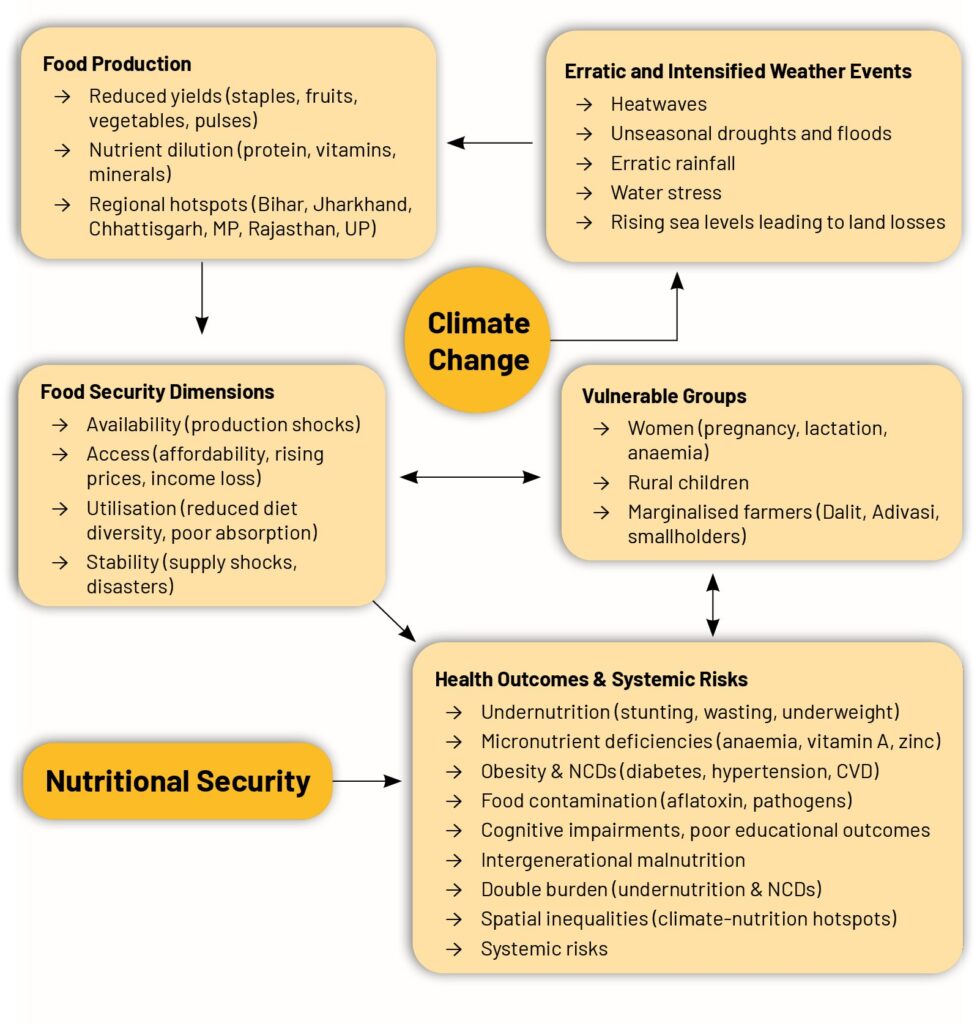
Source: Authors’ own
Intellectual Property Rights, Food Security, and Innovation in India’s Agricultural Landscape
The coexistence of ample food and persistent undernourishment remains a structural paradox in India. It reflects unevenness within modern food systems, particularly in the interaction between technological innovation, institutional frameworks, and social equity. An evolving and well-calibrated IPR landscape presents an opportunity to catalyse investment in adaptive technologies, including stress-tolerant crop varieties, precision agriculture tools, and data-driven agronomic solutions. By strengthening institutional pathways that translate scientific advances into scalable, field-level impact, such a framework can directly support more resilient and inclusive food systems. By aligning IPR frameworks with national food and nutrition priorities, India can foster an innovation ecosystem that accelerates climate-resilient agriculture, enhances productivity, and supports inclusive, long-term food system transformation.
The Evolving IPR Landscape: From Public Domain to Proprietary Control
Historically, scientific advancements in agriculture, especially those contributing to the foundations of food security, have largely emerged from publicly funded laboratories, fostering an environment of shared knowledge and open access. The advent of modern agricultural biotechnology has shifted this paradigm. The proprietary nature of these new technologies has led to a surge in patent filings, marking a distinct departure from past practices.[76] This transition can be understood through two key phases: the first phase involved the adoption of plant breeders’ rights in developed nations, while the second phase involved the groundbreaking introduction of patents on life forms, coinciding with breakthroughs in genetic engineering. Such unprecedented legal protection for IPRs acted as a powerful incentive for drawing the private sector into agro-biotechnology.
Proponents argue that patent protection drives investment in research that benefits all. For instance, it has previously helped in the production of higher-yielding varieties, pest-resistant crops, and nutritionally enhanced foods such as pro-vitamin A rice.[77] These experiences highlight an opportunity to design IPR governance models that simultaneously incentivise innovation and ensure affordability, access, and responsible deployment, particularly smallholder-dominated agriculture systems.
The private sector has, in several instances, played a developmental role. Private companies have been instrumental in developing climate-resilient and nutrition-enhanced crops that directly address the challenges posed by climate change and malnutrition. Examples include drought-tolerant maize, submergence-resistant rice, and biofortified staples such as iron-rich pearl millet. These contributions demonstrate that private innovation, when properly incentivised and regulated, can complement public research by targeting traits critical to India’s food and nutritional security. The challenge is to ensure that such technologies are made accessible and affordable to smallholder farmers rather than being confined to commercial supply chains.
For developing countries such as India, IPR regimes constitute a strategic policy lever to direct innovation toward climate-resilient staples, biofortified crops, and nutrition-sensitive agriculture, thereby aligning trade competitiveness with domestic food and nutritional security priorities.[78] IPR frameworks function as critical enablers of agricultural innovation, as they provide the incentives and legal certainty required to mobilise sustained investment in R&D. In areas such as biotechnology, seed systems, and climate-resilient crop development, appropriately designed IPR regimes support the translation of scientific advances into deployable technologies. In the context of increasing climate variability, effective IPR systems can facilitate the development and dissemination of solutions that address heat stress, drought, pests, and diseases.
In India’s context, balanced IPR policies offer an opportunity to strengthen public–private collaboration, promote technology transfer, and encourage the adaptation of innovations to local agro-ecological conditions, thereby contributing to long-term agricultural resilience, productivity, and food and nutrition security. These considerations reinforce the opportunity for a balanced and context-appropriate IPR framework, one that protects innovation incentives while safeguarding traditional knowledge systems, promoting competition, and ensuring affordable access. Such an approach is increasingly recognised as essential for enabling agricultural innovation that supports climate adaptation and mitigation, strengthens food security, and advances inclusive and resilient agrifood systems.
Innovative licensing models can address some of these challenges. Trait-specific licensing approaches, under which individual genetic traits, such as drought tolerance or pest resistance, are licensed to multiple seed developers on transparent and affordable terms, enable wider diffusion of critical technologies without undermining intellectual property protection. Similarly, open innovation platforms and collaborative R&D frameworks facilitate partnerships among private companies, public research institutions, domestic firms, and farmer organisations, allowing essential traits to be integrated into locally adapted crop varieties. These mechanisms ensure that critical innovations are not over-consolidated by a few corporate players, thereby strengthening the inclusivity of agricultural innovation systems in India. Greater emphasis on public–private partnerships, stewardship programmes, and responsible technology deployment initiatives can further demonstrate how innovation can be shared while maintaining research incentives. Collectively, these approaches reinforce a more inclusive and resilient agricultural innovation ecosystem, supporting climate adaptation and productivity gains while balancing protection, access, and long-term investment.
In the context of smallholder agriculture, the protection of traditional knowledge and biodiversity assumes heightened importance within the evolving IPR landscape. Strengthened and well-designed IPR frameworks offer a critical opportunity to formally recognise, safeguard, and valorise the traditional knowledge systems that farmers and Indigenous communities have nurtured for generations and that continue to underpin agricultural diversity and local food security.[79] By integrating traditional knowledge protection with formal innovation incentives, IPR regimes can play a constructive role in advancing food security objectives, promoting equity, and strengthening justice within agricultural systems, while simultaneously fostering innovation and long-term sustainability.
In addition to licensing and access issues, regulatory clarity is a critical determinant of innovation. India’s current approval processes for genetically engineered crops and new plant varieties are often slow and uncertain, creating disincentives for both domestic and international innovators. Such uncertainty increases investment risk and can deter sustained private sector engagement in agricultural R&D. Establishing transparent guidelines and fast-track approval systems, particularly for varieties with proven climate resilience or nutritional benefits, would accelerate the deployment of much-needed technologies. In a context where climate change is eroding agricultural productivity year by year, regulatory delays can have consequences for food security. Streamlining approval mechanisms, while safeguarding biosafety, could encourage greater private sector participation and ensure that beneficial innovations reach farmers in time. Greater regulatory certainty would not only strengthen confidence among innovators but also help ensure that proven technologies reach smallholders on time, supporting productivity, resilience, and inclusive agricultural growth.
In the context of climate-related challenges, well-designed and effectively implemented IPR regimes can serve as an important enabler of solutions for India’s most vulnerable populations. By incentivising the development of climate-resilient crops and adaptive technologies, balanced IPR frameworks can expand the range of coping options available to smallholder farmers, particularly in warmer and climate-stressed regions with acute vulnerabilities.[80] The challenge of reimagining food and nutritional security amid climate change demands IPR systems that encourage both technological innovation and equitable access. This calls for moving beyond binary debates about patents versus open access toward more sophisticated frameworks that recognise the diverse needs of different stakeholders in agricultural innovation systems.
Rather than being perceived as exclusionary, IPRs can be reimagined as a tool to foster agricultural accessibility and affordability. Mechanisms such as patent pools, tiered pricing, or state-supported licensing schemes could help reduce costs and broaden access to climate-smart and nutrition-enhanced crops. When carefully designed, such frameworks allow innovators to recover investments while ensuring equitable diffusion of technology. In this sense, IPRs can serve as a catalyst for inclusive agricultural transformation—accelerating innovation while protecting the livelihoods of India’s smallholder farmers and enhancing food security.
Global Alignment and Trade Readiness
India’s agricultural innovation and IPR frameworks must also be assessed in light of global trade readiness. With export ambitions in basmati rice, horticultural products, and value-added food items, compliance with international standards has become a critical determinant of market access. Maximum Residue Limits (MRLs) set by the Codex Alimentarius Commission and other international standard-setting bodies often serve as benchmarks for bilateral and multilateral trade. Divergence between Indian standards and Codex norms has occasionally triggered non-tariff barriers, leading to consignments being rejected or subjected to additional scrutiny in global markets.
Indian basmati rice consignments to the European Union (EU), for example, have faced repeated rejections due to traces of tricyclazole and other pesticides exceeding the EU’s more stringent MRLs, despite being considered acceptable under Indian standards. Similarly, Indian mangoes have often encountered phytosanitary barriers in EU markets, where a lack of alignment with Codex norms and inconsistent compliance documentation have limited export growth. These cases highlight how gaps between domestic regulations and international standards can undermine India’s export competitiveness, even in high-demand sectors.
Harmonising India’s domestic regulatory standards with Codex benchmarks, while ensuring that farmer interests and food sovereignty are protected, is therefore essential. This harmonisation must extend to both imports and exports to ensure reciprocity and credibility in trade negotiations. Digital compliance tools, including blockchain-enabled traceability systems and e-certification platforms, can streamline monitoring and verification processes, reduce transaction costs, and build trust with international buyers.
Importantly, IPR regimes intersect directly with this global alignment agenda. Trait-specific licensing and collaborative R&D models that generate pest-resistant, residue-free, and climate-resilient crops can help India meet Codex and importing-country requirements more effectively. Equally, regulatory clarity and fast-track approvals for such innovations would enable Indian exporters to adapt quickly to evolving international standards.
The process needs to be supplemented by knowledge about the global best practices on compliance under varied regulatory regimes. The accumulated knowledge of global agri-business leaders in navigating complex regulatory and compliance regimes across national jurisdictions, even within an economic corridor or a contiguous landmass, is an unexplored domain of trade readiness. This can be witnessed in the ways multinational agri-food companies, operating across Europe, North America, and East Asia, have developed sophisticated systems for complying with MRL standards, traceability requirements, and phytosanitary protocols prevailing across fragmented regulatory environments. In the process, the development of advanced digital traceability tools, integrated residue-monitoring systems, and end-to-end supply chain visibility platforms have emerged as critical levers for accessing high-value export markets. [81]
There is no doubt that India’s agricultural innovation and IPR frameworks can benefit from leveraging global private-sector expertise in regulatory intelligence and compliance infrastructure, and, eventually, having systems in place to navigate the myriad regulatory frameworks across the global ecosystem of their operations. PPP models will enable domestic exporters, especially small and medium players in agribusiness, to access globally benchmarked traceability systems, digital certification tools, and compliance protocols that would otherwise be prohibitively expensive to develop independently. The residue-sensitive exports, such as basmati rice, fruits, vegetables, and processed foods, where even marginal non-compliance can trigger trade disruptions, would benefit from these. It is worthwhile to mention that international harmonisation with Codex benchmarks is an explicit objective in India’s agricultural export policy frameworks to reduce non-tariff barriers and align national standards with global expectations.[82]
In this framework, digital traceability systems that range from blockchain-enabled tracking of the product’s supply chain to AI-driven residue risk profiling can enable a paradigm shift by complementing India’s IPR-enabled technological advancements. This will help ensure a regime in which new crop varieties, inputs, and practices are productive, climate-resilient, and globally compliant with the regulatory norms.[83] With such systems infusing enhanced transparency and accountability across value chains, farmers will benefit through better price discovery and realisation, thereby reducing the reputational risks associated with export rejections.
As such, the initial experiments with export-oriented Indian digital traceability frameworks (e.g., GrapeNet/BasmaNet models) show how robust, technology-based traceability systems can help the process of compliance with the stringent international requirements and protect market access.[84] Therefore, for the effective integration of these new systems, like digital traceability, India’s IPR and regulatory frameworks must explicitly recognise compliance and traceability as innovation domains in their own right. India will be able to adopt the global best practices while retaining domestic control over strategic assets through the promotion of collaborative R&D, co-development of digital compliance infrastructure, and shared standards platforms. In doing so, IPR regimes can evolve beyond instruments of protection and be more aligned towards meeting the needs of market access, meeting the highest global standards, and being more compliant with the myriad regulatory norms. This alignment would strengthen India’s export competitiveness while reinforcing the credibility of its agricultural innovation system in international markets.
India’s Unique Legal Framework for Agricultural IPR
India’s legal framework for IPR in agriculture is distinct from the model followed in many developed countries, reflecting a deeply rooted commitment to social justice and food sovereignty. The three main legal instruments are:
- The Protection of Plant Varieties and Farmers’ Rights (PPV&FR) Act, 2001
- The Indian Patents Act, 1970 (as amended in 2005)
- The Biological Diversity Act, 2002
The PPV&FR Act is a sui generis system that aligns with India’s obligations under the World Trade Organization’s (WTO) Agreement on Trade-Related Aspects of Intellectual Property Rights (TRIPS). It was enacted as a more farmer-centric alternative to the 1978 and 1991 versions of the International Union for the Protection of New Varieties of Plants (UPOV) Convention, which India has not signed. Unlike UPOV 1991, the PPV&FR Act preserves the right of farmers to save, use, exchange, and even sell farm-saved seeds—an aspect considered essential for the protection of traditional agricultural practices and food sovereignty.[85]
Simultaneously, India’s Patents Act excludes from patentability plants and animals in whole or in part (other than microorganisms) and essentially biological processes for the production of plants and animals (Section 3(j)). This means that genetically modified seeds, plant varieties, and breeding methods are generally outside the scope of patent protection. Instead, innovations in plant breeding can be registered under the PPV&FR Act, provided they meet the criteria of novelty, distinctiveness, uniformity, and stability (NDUS).
Aligning Farmers’ Rights with Breeders’ Innovation Incentives
The PPV&FR Act is distinctive in its balanced recognition of the rights of both breeders and farmers, reflecting India’s commitment to a farmer-first innovation framework. By enabling farmers to save, reuse, and exchange seeds, the Act strengthens livelihood security, preserves agrobiodiversity, and reinforces farmer agency within the agricultural value chain.[86] For private breeders, including multinational companies that consider farmers in their business models, this framework offers an opportunity to reimagine innovation pathways that prioritise accessibility, trust, and long-term partnerships with farming communities.
India’s IPR framework in agriculture remains farmer-centric, and the Protection of Plant Varieties and Farmers’ Rights (PPV&FR) authority has made progress in improving registration timelines for new varieties. Building on this momentum, advancing, and fast-tracking draft regulations for provisional protection could further accelerate the release of new varieties while providing early safeguards against infringement during the application process. These steps would enhance confidence among both public and private breeders, fostering greater participation and supporting a more dynamic, innovation-driven, and farmer-focused agricultural ecosystem. Enforcement can also be made more robust through the integration of cost-effective molecular marker technologies, which allow early detection of infringement or misappropriation of proprietary traits. By institutionalising such testing mechanisms, India could strengthen the credibility of its system and reduce disputes that often arise during the application window.
Judicial reforms are equally important. At present, plant variety protection suits are filed at the district court level, leading to delays and inconsistent outcomes. Establishing dedicated IP divisions in all High Courts and amending the PPV&FR Act to allow infringement cases to be brought directly before such divisions would expedite adjudication and improve the predictability of enforcement. This step would also align India more closely with global best practices on specialised judicial forums for intellectual property disputes.
A sustained collaboration between government agencies, industry actors, and research institutions is also a prerequisite for strengthening agricultural IPR enforcement in India. The government and private players, therefore, need to incur capital expenditures to create IPR infrastructure that includes centralised molecular testing facilities, accredited laboratories, and digital variety registries. Tripartite collaborative frameworks with industry participation, along with public research institutions and agricultural universities, can enhance operational expertise, compliance protocols, and funding support, with the latter two being neutral hubs for validation, training, and knowledge dissemination. This will build a credible, transparent, and scalable IPR ecosystem, supporting innovation, protecting farmers’ interests, and enhancing trust across stakeholders.
Finally, clarity is urgently needed on the treatment of emerging technologies such as gene-edited crops and new breeding techniques. Current laws under both the Patents Act and the PPV&FR Act provide limited guidance on whether such products are to be treated as “essentially biological processes” (and therefore excluded) or as eligible for protection. Explicit statutory or regulatory guidance would reduce uncertainty, attract investment, and ensure that India remains adaptive to global innovation trends while safeguarding the interests of farmers.
Advancing IPR Awareness and Capacity in a Global Context
India’s agricultural IPR framework has strong normative foundations and is seeing progress. The PPV&FR Authority has registered over 4,000 plant varieties and expanded farmer awareness programmes, capacity-building initiatives, and digital registration platforms, broadening access to formal IPR protection for both public and farmer-led innovations.[87],[88] In contrast to patent-centric models in the US and EU, India’s approach—shared with countries such as Brazil and South Africa—integrates farmers’ rights, equity, and food security as core principles. This inclusive design positions IPR as a tool for farmer-centric and socially responsive innovation, while ongoing institutional refinement can further strengthen its alignment with emerging agricultural technologies.
Pathways to Nutrition-Sensitive, Climate-Resilient Food Systems
Over 50 percent of Indians—about 790 million people—are unable to afford a healthy diet.[89] Addressing climate variability in food systems demands an innovative, inclusive, and adaptive approach that transcends traditional agricultural paradigms. Agricultural practices need to simultaneously enhance productivity, improve nutritional outcomes, and build climate resilience.
There is a compelling case for integrating climate adaptation with nutritional considerations through Climate-Smart Agriculture (CSA).[e] Nutrition-Sensitive Agriculture (NSA) complements this framework—it nurtures the connections between agriculture, food systems, and health, with the aim of ensuring that agricultural practices contribute to well-being. The synthesis of these approaches creates Nutrition-Sensitive Climate-Smart Agriculture (NSCSA), which “tries to solve the concerns of food security, nutrition, and climate change all at the same time.”[90] Agriculture that is nutrition-sensitive leads to diverse cropping, biofortification, home gardens, and value chains that prioritise nutrient-rich foods.[91]
For instance, leveraging local genetic diversity strengthens diets and resilience. Alliances of farmers and research institutions have revived hundreds of traditional varieties of millet, pulses, and spices; over 100,000 farmers now cultivate 1,000+ native crop varieties on 200,000 ha, boosting both nutritional outcomes and climate adaptation.[92] The work involves modifying crop management practices, improving water management, adopting new farm techniques, crop diversification, improving pest management, better weather forecasts, and crop insurance.[93] The efficient use of natural resources, such as water management, also emerges as a critical adaptation component. Other programmes like rainwater harvesting and micro-irrigation are also used for better water-use efficiency. Mobile apps, AI platforms, or SMS alerts provide real-time guidance on sustainable farming and export standards.[94] Blockchain or QR-code labelling promotes supply chain transparency, ensuring compliance with food safety and export norms.[95]
A recent ORF paper employed econometric modelling to quantify agricultural water use efficiency, specifically through a calorific assessment of crop productivity (Table 1).[96] By analysing the marginal product of water across diverse crops, the paper identified maize and ragi as more water-efficient than rice, a staple dominating India’s agricultural landscape and food security infrastructure. The study investigated the nutritional benefits and water conservation potential of transitioning away from rice cultivation, and outlined policy recommendations designed to incentivise this strategic shift.
Table 1: Marginal Product of Water in Terms of Nutritional Values of Different Crops
| Nutrients Per Litre | Rice | Wheat | Jowar | Ragi | Bajra | Barley |
| Energy (Calories /Litre) | 490 | 1618 | 691 | 1643 | 1383 | 1404 |
| Protein (Milligrams/Litre) | 10 | 55 | 21 | 37 | 44 | 48 |
| Iron (Micrograms/Litre) | 1 | 25 | 8 | 20 | 31 | 7 |
| Fibre (Milligrams/Litre) | 0.3 | 6 | 3 | 18 | 5 | 16 |
| Carbohydrates (Milligrams/Litre | 109 | 331 | 144 | 361 | 259 | 291 |
| Fats (Milligrams/Litre) | 1 | 7 | 4 | 7 | 19 | 5 |
| Calcium (Micrograms/Litre) | 14 | 191 | 50 | 1723 | 161 | 109 |
| Phosphorous (Micrograms/Litre) | 270 | 1423 | 440 | 1418 | 1134 | 899 |
Source: D’souza et al.[97]
A strategic shift away from water-intensive rice cultivation towards more sustainable alternatives is increasingly necessary. Existing policy instruments—such as assured procurement, Minimum Support Price (MSP), and electricity subsidies—create incentives that favour rice and wheat cultivation even in water-scarce regions. There is a need to offer comparable economic incentives for less water-intensive, nutrient-rich crops, appropriately pricing irrigation and electricity, and encouraging agro-climatic mapping to guide crop diversification. Research should be conducted on optimal irrigation strategies, development of drought-resistant varieties, and promotion of best farming practices to improve yields. Alongside farmer incentives, consumer awareness must be built to encourage dietary shifts.
Ensuring nutrition-sensitive and climate-resilient food systems requires more than innovation. Strong land and resource rights, local decision-making, and community institutions are some of the fundamental socio-political enablers of resilient food systems. Women and marginal groups, who are smallholders, often lack secure land tenure, access to diverse seeds, and a voice in governance, which undermines their adaptive capacity.[98] Farmers should be able to save, exchange, and market seeds, have rights to land and water, and be able to contribute to policymaking. India’s Protection of Plant Varieties and Farmers’ Rights Act and many international treaties also recognise farmers’ seed sovereignty, but effective implementation requires support for community seed banks and participatory breeding.[99] Evidence has shown that community seed networks and plant-biodiversity projects, backed by policy, can allow farmers to maintain and improve traditional varieties while generating income.[100]
Local governance bodies such as Gram Sabhas, Panchayats, cooperatives, and FPOs also play a role in making food systems resilient. Climate vulnerability varies by region and community, so decentralised planning enables context-specific adaptation. In Uttar Pradesh, for instance, climate adaptation mandates have been integrated into Gram Panchayat development plans, with women’s SHGs and village committees involved in assessing hazards and planning interventions.[101] Including women and other small, marginal farmers in governance, ensuring land rights, and securing their irrigation rights have the potential to buffer climate risks.
On-farm practices that enhance ecosystem health and climate resilience are vital. CSA techniques complement agroecological approaches, including soil fertility management, agroforestry, and diversified cropping. Integrated Modern Climate-Resilient agriculture combines these methods to enhance productivity, resilience, and sustainability. Small farmers who grow vegetables and produce cereals have adopted many of these practices, such as conservation tillage, crop rotation, organic inputs, agroforestry, drip irrigation, and rainwater harvesting, and these have shown strong promise.[102] Rainwater harvesting and laser land levelling in arid regions alone have improved water efficiency and yields by about 18–40 percent.[103] Some precision agriculture techniques have also been used to guide planting and irrigation decisions, monitor yields, and fine-tune inputs to achieve improved productivity while reducing water and fertiliser consumption.[104]
Inclusive Agricultural Innovation
Technological and institutional innovation must be inclusive to effectively serve India’s millions of small and marginal farmers. Farmer-centric R&D, digital advisory tools, and strengthened market linkages are central to building resilient and scalable innovation systems. In recent years, public–private partnerships[105] and multi-stakeholder platforms[106] have co-created locally adapted solutions, leveraging digital technologies to deliver targeted advisories, improve access to markets and credit, and strengthen farmer collectives.[107],[108]
CSA approaches further enhance inclusion by supporting women’s participation, expanding access to microfinance, crop insurance, and cooperatives, and fostering climate-smart villages where farmers jointly develop adaptation strategies. Institutional models such as SHGs, cooperatives, FPOs, and CBOs have played a pivotal role in scaling resilient practices by facilitating knowledge transfer, collective bargaining, and risk-sharing, thereby reducing individual costs and vulnerabilities.[109],[110],[111]
Government initiatives to promote FPOs, alongside national missions on sustainable agriculture, have mainstreamed practices such as diversified cropping, integrated farming systems, and resource-efficient technologies.[112] Government and private initiatives (Kisan Knowledge Management System, soil health apps, and market information services) also enable the spread of digital agriculture platforms, which put information in farmers’ hands. Aadhaar-linked land records, unified farmer registries, and mobile e-wallets reduce leakages and make subsidies (fertiliser, power) more efficient and equitable.[113]
Although these innovations aim to ensure that no farmer is left behind, without tailoring solutions to local needs and building trust, these innovations might bypass India’s 500 million small farms.[114] Achieving inclusive growth in agriculture requires addressing structural inequalities that can weaken agriculture-nutrition linkages. The concentration of small and marginal farmers varies across states, with 70-80 percent of landholdings in West Bengal, Bihar, and Kerala held by small and marginal farmers, while rural poverty exceeds 50 percent in Bihar, Chhattisgarh, Orissa, and Madhya Pradesh.[115]
Addressing issues of caste and gender discrimination within CRA systems is essential for promoting inclusivity and ensuring equitable access to resources and decision-making processes.[116] An exploratory study of women-led FPOs in India finds it significant for mainstreaming gender in agriculture, improving women’s visibility, access to resources, and economic empowerment.[117] Evidence from women-led farmer collectives demonstrates potential for improving women’s visibility, access to resources, and economic empowerment. Continued focus on trust-building, gender-responsive institutions, and locally grounded innovation will be essential to ensure that technological progress translates into broad-based, climate-resilient agricultural transformation.[118],[119]
Policy and Programmatic Recommendations
Reorienting Agricultural Policy toward Nutrition-Sensitive and Climate-Resilient Food Systems
To solve problems at the intersection of climate change, food security, and nutrition in India demands comprehensive policy responses that integrate multiple sectors and stakeholders. India’s policy framework must evolve beyond traditional agricultural approaches to embrace innovation, inclusion, and adaptation strategies. While sector-specific intervention may sometimes be sufficient, the complex nature of climate-nutrition-agriculture interaction demands integrated solutions.[120]
Historical analysis reveals gaps in policy convergence, with food-security sectors primarily oriented toward ensuring availability and access to food while neglecting nutritional dimensions.[121] There are alarming trends in climate-induced nutritional degradation as well. Public health is facing threats across various states due to climate change-induced reductions in the nutritional content of key crops such as rice and wheat.[122] This phenomenon necessitates proactive policy interventions focused on biofortification and nutritional enhancement strategies. A holistic paradigm of food and nutrition value chain security must begin with sustainable resource use, particularly water. Current literature emphasise how MSP regimes have led to higher acreage of water-consuming paddy and wheat, displacing more nutritious millets.[123] Therefore, increasing the MSPs for the nutritious millets like Ragi can send important price signals to change the cropping patterns.
Promoting climate-resilient farming practices, including crop diversification, conservation agriculture, and agroforestry, is essential in vulnerable and rain-fed states such as Odisha, Andhra Pradesh, and Tamil Nadu.[124]
These approaches form the core of nutrition-sensitive and climate-resilient food systems. Crop diversification and agrobiodiversity, through the integration of pulses, millets, vegetables, and other native crops into rotations, enhance dietary diversity while improving resilience to climatic shocks. Practices such as mixed cereal–millet cropping and legume intercropping exemplify this approach. Parallel efforts to mainstream resilient crops such as millets and sorghum, known for their drought tolerance and nutritional density, reflect a convergence of traditional knowledge systems and modern agronomic science, as evidenced by the adoption of natural farming practices by nearly three million farmers across India.[125],[126]
Strengthening Seed Systems, Value Chains, and Institutional Coordination
The long-term success of crop diversification and agrobiodiversity also depends on well-designed policy instruments that make such practices economically viable for farmers. A promising pathway is the use of carbon credits, where diversified and low-input cropping systems are rewarded for their capacity to enhance soil carbon sequestration and reduce greenhouse gas emissions. Similarly, nutritional premiums can be integrated into procurement and pricing frameworks, rewarding farmers for cultivating nutrient-dense crops such as pulses, millets, and vegetables that directly address India’s dual burden of malnutrition and obesity. Another complementary approach is climate-linked insurance, which can de-risk farmers adopting diversified systems by providing payouts linked to weather shocks, thereby reducing their reliance on monocultures. Together, these instruments create an enabling ecosystem where environmental sustainability, nutritional security, and farmer livelihoods are mutually reinforcing objectives.
Participatory breeding and community seed banks can ensure access to climate-resilient, nutrient-dense seeds. It also becomes important in limiting effects on productivity, particularly in rice-wheat systems such as in states like Odisha, Andhra Pradesh, and Tamil Nadu. Biofortification and supplementation programmes where cultivating biofortified staples (e.g., iron-fortified millet, Vitamin A-rich sweet potatoes) along with staple grains can help meet micronutrient needs such as iron, zinc, and Vitamin A.[127] Government school-feeding and safety-net programmes can incorporate fortified foods and diverse local produce. For instance, rice-fortification pilots in Kerala reduced anaemia by 20 percent in schoolchildren.[128] There are, however, concerns that IPR might stall private participation in initiatives like quality protein maize development.[129]
Strengthening nutritional security along with ensuring sustainable use of natural resources will also require policy shifts that move beyond crop-neutral support structures. Agro-climatic zoning can serve as a critical tool for aligning cropping patterns with ecological realities, encouraging the cultivation of crops best suited to local soil, water, and climate conditions. Such zoning frameworks can help reduce the over-exploitation of water-intensive crops in semi-arid regions while promoting pulses, millets, oilseeds, and horticultural crops in zones where they thrive naturally.
This needs to be complemented by adaptive procurement policies, which recalibrate the MSP and public procurement mechanisms to diversify beyond rice and wheat. By guaranteeing markets for climate-resilient and nutrition-rich crops such as millets, pulses, and indigenous varieties, adaptive procurement can create powerful incentives for farmers to shift production. Linking procurement to mid-day meal schemes, ICDS programmes, and public distribution systems would further ensure that the benefits of diversified agriculture translate into improved dietary outcomes.
Creating nutrition-sensitive value chains by investing in rural markets and providing storage and processing facilities for fruits, vegetables, and legumes helps translate farm diversity into accessible diets. Public interventions (e.g., FPOs, cold chains) can link smallholders, including women, to the demand for nutritious crops. Social programmes like mid-day meals and public distribution can be strengthened with climate-protected supply chains and local procurement of nutritious grains.
Governing Innovation, Data, and Digital Systems for Equitable Climate Adaptation
Despite the growing availability of climate-resilient agricultural technologies, the most crucial policy challenge lies not in innovation, but in ensuring that innovation systems translate effectively into broad-based and equitable farmer adoption. In this context, IPRs play a critical and largely constructive role. When appropriately designed and governed, IPR regimes can incentivise sustained investment in agricultural research and development, facilitate technology transfer, and support the scaling of climate-resilient and nutrition-sensitive innovations. India’s legal framework provides a strong foundation in this regard, with the PPV&FR Act, 2001, serving as a cornerstone that balances breeder incentives with farmer rights.[130] The availability of multiple forms of IPR protection enables portfolio development and supports viable business models for public and private technology developers, thereby strengthening the overall innovation ecosystem. The policy priority, therefore, is not to weaken IPR safeguards, but to integrate them strategically within agricultural development pathways so that innovation protection and farmer welfare are mutually reinforcing.
This enabling role of IPR extends to climate-resilient seed varieties, where social status emerges as a key determinant of adoption, necessitating targeted strategies for equitable access to marginalised communities, including Dalit and Adivasi farmers.[131] The Indian Council of Agricultural Research has developed more than 800 climate-resilient crop varieties, yet their dissemination faces regulatory and IPR challenges.[132] Policy recommendations emphasise the need for guidance on regulatory processes and guidelines to help seed banks navigate seed certification, intellectual property rights, and environmental clearances.[133] Collaborative approaches involving philanthropy, impact-first investors, and government support can address these barriers while maintaining incentives for innovation.
The implementation of IPR frameworks in developing countries such as India presents an important opportunity to move beyond a narrow focus on productivity enhancement toward a more holistic innovation ecosystem.[134] Expanding IPR regimes to encompass trademarks, patents, and geographical indications can provide comprehensive protection for farmers’ distinctive products, traditional knowledge, and place-based practices, while also enhancing value addition, market differentiation, and long-term income opportunities.[135] The success of Basmati rice protection through geographical indication (GI) tags in 2016 exemplifies how IPR mechanisms can safeguard traditional agricultural varieties while enabling farmers to benefit from commercialisation. Still, there remains a constant tension between individual appropriation through IPRs and traditional knowledge-sharing systems that creates challenges for policy implementation, particularly given that IPR is linked with property rights such as rights to land and other biological resources.
Five clear steps are required. First, there should be legal clarity and harmonisation between the PPV&FR Act, the Patents Act, and Biodiversity Act. Second, there should be trait-specific IPRs instead of patenting seeds, allowing patents for novel genetic traits with provisions for affordable, compulsory licensing. Third, PPPs should be encouraged to facilitate joint research between ICAR, state agricultural universities, and start-ups with appropriate benefit-sharing models. Fourth, the PPV&FR Authority should be strengthened to improve outreach, simplify registration processes, and provide legal aid to farmer breeders. Fifth, agri-biotech start-ups should be incentivised through targeted grants, incubation, and fast-track IPR services.
The policy framework must also address critical weaknesses in international agreements, particularly the Convention on Biological Diversity (CBD), which suffers from weak enforcement mechanisms and over-reliance on national sovereignty that may not adequately protect local community rights.[136]
Despite being legally binding, the CBD has little power to ensure compliance, which creates gaps in bio-piracy protection. To strengthen IPR integration, policies must focus on capacity-building for R&D professionals in IPR and technology commercialisation, encouraging technology developers to enter as start-ups within university curricula aligned with the National IPR Policy.[137] Critical recommendations in this regard can include organising awareness-generation camps in villages through NGOs, and leveraging media platforms to mainstream biodiversity conservation and community rights issues.[138]
The modernisation of data systems for monitoring food and nutrition security can also enhance India’s agricultural resilience. The integration of AI and digital tools has become central to climate-resilient agriculture, with AI-driven decision systems using climate, soil, and crop data to enhance farm-level decision-making.[139] AI-enabled advisories, IoT applications, and sensor technologies can reduce climate-related risks while advancing agricultural sustainability.[140] These systems are particularly important amid frequent food supply disruptions caused by extreme weather events, including floods and cyclones, especially in states such as Bihar, Odisha, and West Bengal. Weather forecasting and early warning systems form the backbone of effective monitoring systems. Research shows how farmers with awareness of weather events tend to respond by planting more appropriate crops or varieties and adopting other suitable crop management techniques.[141] Early warning systems utilising extensive climate monitoring and prediction capabilities emerge as essential tools for designing region-specific agricultural programmes. They help in improving weather forecasting, real-time monitoring, improving disaster preparedness, and minimising risks of climate adversaries by minimising disruptions across stakeholders along the supply chain.[142],[143]
Digital platforms also enhance market intelligence, e-commerce participation, and precision agriculture, facilitating a transition from labour-intensive to knowledge-intensive farming systems.[144] Applications such as remote sensing in crop insurance and weather-indexed insurance schemes improve policy effectiveness by enabling rapid payouts and reducing reliance on negative coping strategies.[145] Comprehensive food and nutrition security monitoring systems must integrate both general indicators and shock-specific parameters, including health outcomes and intra-household food access.[146] Rather than creating parallel architectures, policy efforts should prioritise interoperability across existing food, nutrition, and climate databases to generate integrated insights into systemic risks and vulnerabilities.[147]
FPOs play a pivotal role within this digitally enabled ecosystem by serving as institutional conduits for access to inputs, technologies, credit, and markets. Digital tools can strengthen FPO capacities for collective procurement, aggregation, and marketing, while linking them to platforms such as the Open Network for Digital Commerce[f] to facilitate entry into higher-value segments of agricultural value chains.[148] Finally, sustained investments in micro-level research, participatory data collection, satellite and drone technologies, and rigorous impact-assessment frameworks are essential for developing context-specific adaptation strategies, strengthening accountability, and ensuring that climate action remains both inclusive and evidence-driven.[149]
Conclusion
The cascading impacts of climate change, food insecurity, and evolving intellectual property (IP) regimes present India with both challenges and opportunities, necessitating transformative responses across governance, innovation, and social equity. Climate change, among other global challenges, underscores the importance of strengthening India’s food and nutritional security. It brings renewed focus to food accessibility, utilisation, and stability, highlighting the need for inclusive strategies that enhance security.
In this context, IP regimes present substantial opportunities for enabling innovation. While they incentivise the development of climate-resilient technologies, they also open pathways to improve access and adoption for smallholder farmers. In India, IP frameworks offer scope to further energise innovation ecosystems. The government’s approach to harmonising corporate control and farmer innovation, particularly concerning seed sovereignty and traditional knowledge systems, will play a decisive role in ensuring that technological progress advances equity, productivity, and sustainability.
Pathways toward nutrition-sensitive, climate-resilient food systems call for integrated, cross-sectoral approaches that promote both CSA and NSA to enhance productivity, nutritional outcomes, and climate responsiveness. The involvement of local governance structures, such as Gram Sabhas, Panchayats, and FPOs, can facilitate the adoption of effective adaptive strategies and the development of context-specific responses through participatory breeding programmes and community seed banks. A strategic shift from production-centred frameworks to those prioritising nutrition, sustainability, and social inclusion can further strengthen food system resilience.
Moreover, the integration of IP safeguards within national agricultural strategies presents an opportunity to balance between fostering innovation and ensuring equitable access and distribution. Digital platforms and robust data monitoring offer opportunities to democratise access to information, markets, and technologies. This calls for coordinated governmental efforts to address structural gaps and ensure that these solutions actively empower India’s most vulnerable agricultural communities.
With projections indicating that a large share of India’s population may face nutritional stress by 2050 despite anticipated increases in global food production, the scope for proactive adaptation is substantial. The strategic choice lies in embracing systemic transformation, demanding a fundamental reimagining of food systems as integrated networks delivering nutrition, sustainability, and resilience concurrently.
Shoba Suri is Senior Fellow, Health Initiative, Observer Research Foundation.
Nilanjan Ghosh is Vice President, Development Studies, Observer Research Foundation.
All views expressed in this publication are solely those of the authors, and do not represent the Observer Research Foundation, either in its entirety or its officials and personnel.
Endnotes
[a] Affordability is a critical component of economic accessibility, as it determines whether people can actually buy the food that is available.
[b] Temperature sensitivity varies across crops and regions.
[c] AgriStack is a unified Digital Public Infrastructure (DPI) for agriculture in India, approved by the Union Cabinet in September 2024 to create a secure, federated database of farmers, land records, and crops.
[d] These districts are primarily located in Bihar, Chhattisgarh, Gujarat, Haryana, Jharkhand, Karnataka, Madhya Pradesh, Maharashtra, Rajasthan, and Uttar Pradesh.
[e] CSA is defined as “a sustainable farming approach that attempts to maximise resource utilisation, improve long-term agricultural sustainability, and prevent environmental degradation while improving agricultural income and production.”
[f] initiated by the Government of India, specifically under the Department for Promotion of Industry and Internal Trade (DPIIT) in the Ministry of Commerce and Industry in 2022.
[1] Shivani Rohatgi et al., “Trends of Malnutrition from 1947-2021 among Under-five Children in India,” Current Medicine Research and Practice 11, no. 6 (2021): 269-271.
[2] Ministry of Agriculture & Farmers Welfare, Department of Agriculture & Farmers Welfare, Economics, Statistics & Evaluation Division, “Agricultural Statistics at a Glance 2023,” https://desagri.gov.in/wp-content/uploads/2024/09/Agricultural-Statistics-at-a-Glance-2023.pdf.
[3] “In Gujarat’s Cities, Diets Still Run on Cereals,” Times of India, July 9 2025, https://timesofindia.indiatimes.com/city/ahmedabad/in-gujarats-cities-diets-still-run-on-cereals/articleshow/122327128.cms.
[4] Rohatgi et al., “Trends of Malnutrition from 1947-2021 among Under-five Children in India”.
[5] Meera Shekar et al., ‘Scaling Up Nutrition in the Democratic Republic of Congo: What Will It Cost?,’ World Bank Discussion paper, March 2015, https://documents1.worldbank.org/curated/en/510801506583879408/pdf/120109-WP-ScalingUpNutritionDRCFINAL-PUBLIC.pdf
[6] Food Security Cluster Handbook, “The Four Pillars of Food Security,” https://handbook.fscluster.org/docs/231-the-four-pillars-of-food-security.
[7] Surabi Dutta and Suprity Shyam, “The Effects of Climate Change on Rural Livelihood and Food Security in India,” EPRA International Journal of Economic Growth and Environmental Issues 12, no. 5 (2024): 1-1.
[8] Ajay Kumar and Pritee Sharma, “Impact of Climate Variation on Agricultural Productivity and Food Security in Rural India,” SSRN Electronic Journal (2022), https://doi.org/10.2139/ssrn.4144089.
[10] Dutta and Shyam, “The Effects of Climate Change on Rural Livelihood and Food Security in India”.
[11] “Climate Change Is Reshaping India’s Agriculture Sector,” Policy Circle, March 24, 2025. https://www.policycircle.org/environment/climate-change-agriculture-impact/.
[12] Abhishek Das et al., “Effects of Climate Change on Food Security and Nutrition in India: A Systematic Review,” Current Research in Environmental Sustainability 9, January 2025:100286, https://doi.org/10.1016/j.crsust.2025.100286.
[13] Dutta and Shyam, “The Effects of Climate Change on Rural Livelihood and Food Security in India”.
[14] “Climate Change Is Reshaping India’s Agriculture Sector”
[15] Dutta and Shyam, “The Effects of Climate Change on Rural Livelihood and Food Security in India”.
[16] Department of Science and Technology, Government of India, Report on climate change and agriculture (New Delhi: Department of Science and Technology, 2024), https://dst.gov.in/sites/default/files/Report_DST_CC_Agriculture.pdf.
[17] Food and Agriculture Organization, The State of Food Insecurity in the World 2001, 2022.
[18] UNISDR, Annual Report 2018, Geneva, United Nations Office for Disaster Risk Reduction, 2018.
[19] Ch. Srinivasa Rao et al., Climate Change and Indian Agriculture: Impacts, Coping Strategies, Programmes and Policy (Hyderabad: Indian Council of Agricultural Research, Ministry of Agriculture and Farmers’ Welfare and Ministry of Environment, Forestry and Climate Change, 2020), ISBN 978‑81‑943090‑5‑5.
[20] Ch. Srinivasa Rao et al., Climate Change and Indian Agriculture: Impacts, Coping Strategies, Programmes and Policy, 2020.
[21] India Budget, Economic Survey 2024-25, https://www.indiabudget.gov.in/economicsurvey/doc/echapter.pdf.
[22] P.K. Aggarwal, “Impact of Climate Change on Indian Agriculture,” Journal of Plant Biology 30, no.2 (2003): 189-198, https://www.researchgate.net/publication/284658547_Impact_of_climate_change_on_Indian_agriculture.
[23] S. Kumar et al., “Effects of Climate Change on Food Security and Nutrition in India: A Systematic Review,” Current Research in Environmental Sustainability 9, 100286.
[24] Abhishek Das et al., ICRISAT and WFP: India Working Paper: Effects of Climate Change on Food Security and Nutrition in India: A Systematic Review (Hyderabad, India: World Food Programme and ICRISAT, 2023), https://oar.icrisat.org/12328/1/ICRISAT%20and%20WFP%20India%20working%20Paper_Effects%20of%20Climate%20change%20on%20Food%20Security%20and%20Nutrition%20of%20India.pdf
[25] Aggarwal, “Impact of Climate Change on Indian Agriculture”.
[26] Department of Science and Technology, Government of India, Report on Climate Change and Agriculture (New Delhi: DST, 2023).
[27] K. Byjesh et al. “Impact of Climate Change on Maize Production in India,” Agricultural Research, 2010.
[28] “ICRISAT and WFP: India Working Paper: Effects of Climate Change on Food Security and Nutrition in India: A Systematic Review”
[29] Das et al., “Effects of Climate Change on Food Security and Nutrition in India: A Systematic Review”.
[30] J.K. Parida, “Climate Change and Its Impact on Rural Livelihoods,” Economic and Political Weekly, 2017.
[31] Department of Science and Technology, Report on Climate Change and Agriculture.
[32] Department of Science and Technology, Report on Climate Change and Agriculture.
[33] ICAR-National Academy of Agricultural Research Management (NAARM), ICAR-NAARM Policy on Climate Change and Agriculture (Hyderabad, India: ICAR-NAARM, 2020), https://naarm.org.in/wp-content/uploads/2020/06/ICAR-NAARM-Policy-on-Climate-Change-and-Agriculture_compressed.pdf.
[34] Naresh Devineni, Shama Perveen, and Upmanu Lall, “Solving Groundwater Depletion in India while Achieving Food Security,” Nature Communications 13, no. 1 (2022): 3374, https://doi.org/10.1038/s41467-022-31122-9.
[35] Aggarwal, “Impact of Climate Change on Indian Agriculture”.
[36] Department of Science and Technology, Report on Climate Change and Agriculture.
[37] A.V.V. Koundinya et al., “Climate Change and Vegetable Production in India,” Scientia Horticulturae, 2018.
[38] Dhiman Mukherjee, “Food Security Under the Era of Climate Change Threat,” Journal of Advanced Agriculture & Horticulture Research 1, no. 1 (2021): 1–4, https://doi.org/10.55124/jahr.v1i1.78.
[39] Department of Science and Technology, Report on Climate Change and Agriculture.
[40] S. Pande et al., “High throughput Phenotyping of Chickpea Diseases: Stepwise Identification of Host Plant Resistance,” Information Processing in Agriculture 2, no. 3-4 (2011): 156-164.
[41] Department of Science and Technology, Report on Climate Change and Agriculture.
[42] K.N. Ninan et al., “Climate Change and Indian Agriculture: Impacts and Adaptation,” Climate Change and Agriculture in India, 2012.
[43] P.K. Aggarwal et al., “Climate Change and Indian Agriculture: Impacts and Adaptation Strategies,” Indian Journal of Agricultural Sciences, 2004.
[44] J.P. Siry, “Food Security and Global Population Trends,” Global Food Security, 2013.
[45] “Bt Brinjal: Pest-Resistant Genetically Modified Eggplant • Food Safety Institute,” Food Safety and Quality Institute, January 25, 2024, https://foodsafety.institute/food-biotechnology/bt-brinjal-pest-resistant-eggplant/.
[46] Sahil Kamra, “The role of Plant Breeding and Genetics for Sustainable Agriculture,” LPU, June 20, 2025, https://www.lpu.in/blog/the-role-of-plant-breeding-and-genetics-in-sustainable-agriculture.
[47] J Arumai Ruban et al., “Entrepreneurial Innovation in Indian Agriculture: A Case Study on Fasal’s IoT-Driven Smart Farming Solutions,” International Journal of Creative Research Thoughts (IJCRT) 12, no. 8 (2024): 2320–2882, https://www.ijcrt.org/papers/IJCRTAN02033.pdf.
[48] Namrata Dubashi et al., “How Agtech Is Poised to Transform India into a Farming Powerhouse,” McKinsey & Company, May 10, 2023, https://www.mckinsey.com/industries/agriculture/our-insights/how-agtech-is-poised-to-transform-india-into-a-farming-powerhouse.
[49] Ashutosh Jha and Snehal Shah, “Value Creation in AgriTech Ecosystems through ITCMAARS,” Journal of Information Technology Teaching Cases, March 11, 2025, https://doi.org/10.1177/20438869251325242.
[50]“NITI Aayog Forges Agreement with Microsoft India to Bring the Power of AI to the Masses,” Microsoft Stories India, October 12, 2018, https://news.microsoft.com/en-in/niti-aayog-microsoft-india-ai-agreement/.
[51] Cropin, “About – Cropin,” July 24, 2025, https://www.cropin.com/about/.
[52] World Bank, “Maharashtra Project on Climate Resilient Agriculture Phase II,” May 15, 2025, https://documents1.worldbank.org/curated/en/099051625050513670/pdf/P510429-07cbe756-d79a-4f1e-9cd3-0858b6b2a991.pdf.
[53] Vineet Kumar, “Maharashtra’s Project Funds for Climate-Resilient Agriculture Has Gone to Just a Few Districts and Types of Interventions,” Down to Earth, November 13, 2023, https://www.downtoearth.org.in/agriculture/maharashtra-s-project-funds-for-climate-resilient-agriculture-has-gone-to-just-a-few-districts-and-types-of-interventions-92766.
[54] Department of Administrative Reforms and Public Grievances, Government of India, Viksit Bharat-Secure and Sustainable e-Services Delivery (New Delhi: Department of Administrative Reforms and Public Grievances), https://nceg.gov.in/assets/pdf/27th_NCeG_Compendium_Booklet.pdf.
[55]“Climate Change Is Exacerbating India’s Nutrition and Health Insecurity,” Financial Express, March 20, 2019, https://www.financialexpress.com/opinion/climate-change-is-exacerbating-indias-nutrition-and-health-insecurity/1508679/.
[56]“Climate Change Is Exacerbating India’s Nutrition and Health Insecurity”.
[57] Aggarwal, “Impact of Climate Change on Indian Agriculture”.
[58] “Climate Change, Food and Nutritional Security: Issues and Concerns in India,” Journal of Climate Change 2, no.1 (2016), https://cspub-jcc-submission.org/index.php/jcc/article/view/48.
[59] Bidhubhusan et al., “Vulnerability of Agriculture to Climate Change Increases the Risk of Child Malnutrition: Evidence from a Large-Scale Observational Study in India”.
[60] Dutta and Shyam, “The Effects of Climate Change on Rural Livelihood and Food Security in India”.
[61] “Climate Change, Food and Nutritional Security: Issues and Concerns in India”.
[62] Jessica C. Fanzo et al., “Climate Change and Nutrition-Associated Diseases,” Nature Reviews Disease Primers 7, no. 1 (2021): 90, https://doi.org/10.1038/s41572-021-00329-3.
[63] “Effects of Climate Change on Food Security and Nutrition in India: A Systematic Review.” ScienceDirect (2025). https://www.sciencedirect.com/science/article/pii/S266604902500009X.
[64] Das et al., “Effects of Climate Change on Food Security and Nutrition in India: A Systematic Review”.
[65] “Climate Change, Food and Nutritional Security: Issues and Concerns in India”.
[66] “Climate Change, Food and Nutritional Security: Issues and Concerns in India”.
[67] “Indirect Impacts of Malnutrition on Women and Children,” IIP Series, 2025, https://iipseries.org/assets/submission/iip2023C03A85EB91AC335.pdf.
[68] Anant Bhagwati et al., “Building Climate Resilience and Prosperity: Six Bold Bets for Smallholder Farmers and Farm Workers,” HSBC-United Way-The Bridge Span Group, August 2024, https://www.bridgespan.org/getmedia/5df2f077-ea64-4037-b4eb-88fa6e4e7754/bold-bets-to-build-climate-resilience-and-prosperity-in-India.pdf?ext=.pdf
[69] “Climate Change Is Exacerbating India’s Nutrition and Health Insecurity”.
[70] “Climate Change Is Exacerbating India’s Nutrition and Health Insecurity”.
[71] “Children in Indian Districts with High Climate Vulnerability More Likely to Suffer from Malnutrition,” Population Council, May 4, 2023, https://popcouncil.org/insight/children-in-indian-districts-with-high-climate-vulnerability-more-likely-to-suffer-from-malnutrition/.
[72] Das et al., “Effects of Climate Change on Food Security and Nutrition in India: A Systematic Review”.
[73] Dutta and Shyam, “The Effects of Climate Change on Rural Livelihood and Food Security in India”.
[74] Mahapatra et al., “Vulnerability of Agriculture to Climate Change Increases the Risk of Child Malnutrition: Evidence from a Large-scale Observational Study in India”.
[75] Mahapatra et al., “Vulnerability of Agriculture to Climate Change Increases the Risk of Child Malnutrition: Evidence from a Large-Scale Observational Study in India”.
[76] “Intellectual Property Rights and Agricultural Biotechnology,” ISAAA.org, https://www.isaaa.org/resources/publications/pocketk/9/default.asp.
[77] Philippe Cullet, “Food Security and Intellectual Property Rights in Developing Countries,” International Environmental Law Research Centre, 2003, https://www.iprsonline.org/content/w0303.pdf.
[78] “IPR, Innovation & Agriculture,” Federation of Seed Industry of India, https://fsii.in/ipr-innovation-agriculture/.
[79] Cullet, “Food Security and Intellectual Property Rights in Developing Countries”.
[80] Dutta and Shyam, “The Effects of Climate Change on Rural Livelihood and Food Security in India”.
[81] Trace X, “Maximum Residue Limit,” https://tracextech.com/resources/glossary/what-is-maximum-residue-limit/.
[82] Department of Commerce, Ministry of Commerce and Industry, Government of India, Agriculture Export Policy, https://www.commerce.gov.in/wp-content/uploads/2020/02/NTESCL636802085403925699_AGRI_EXPORT_POLICY.pdf.
[83] Sylvain Charlebois et al., “Digital Traceability in Agri-Food Supply Chains: A Comparative Analysis of OECD Member Countries,” Foods 13, no. 7 (2024), https://www.mdpi.com/2304-8158/13/7/1075.
[84] Crop Life India, Workshop on From Field to Fork: Ensuring Basmati Purity through Comprehensive Traceability in Punjab, 2025, https://croplifeindia.org/wp-content/uploads/2025/06/CropLife-Basmati-Report-converted-1.pdf.
[85] S. Sahai, “The Protection of Plant Varieties and Farmers’ Rights Act, 2001: A Review,” Journal of Intellectual Property Rights 8, no. 6 (2003): 461-468.
[86] M. Rai et al., “Intellectual Property Rights in Agricultural Biotechnology: An Indian Perspective,” Current Science 86, no. 4 (2—4), 503-509.
[87] Mohammad Hasibul, “Examining the Impact of Artificial Intelligence on Decision-Making and Customer Relationship Management in Management Information Systems: A Qualitative Study,” Library Progress International 44, no. 3 (2024): 679–98, https://doi.org/10.48165/bapas.2024.44.2.1.
[89] Global Hunger Index, Global Hunger Index: India, 2023, https://www.globalhungerindex.org/india.html.
[90] Hiba Mekyassi et al., “The Role of Nutrition-Sensitive Climate-Smart Agriculture in Ensuring Global Food Security,” BIO Web of Conferences 85, no. 01055 (2024), https://doi.org/10.1051/bioconf/20248501055.
[91] Lakshmy Choudhary et al., “Evidence of Potential Impacts of a Nutrition-Sensitive Agroecology Program in Andhra Pradesh, India, on Dietary Diversity, Nutritional Status, and Child Development,” PLOS ONE 19, no. 5 (2024): e0286356.
[92] Alliance of Bioversity International and CIAT, “From Twenty to Bounty: Indian Farmers Harvest Gains from Conserved Traditional Varieties,” Impact Story, May 13, 2025.
[93] Department of Science and Technology, Report on Climate Change and Agriculture“.
[94] “Kisan Suvidha,” Kisansuvidha, https://kisansuvidha.gov.in/.
[95] Ashkan Pakseresht et al., “Blockchain Technology Characteristics Essential for the Agri-Food Sector: A Systematic Review,” Food Control 165, 2024:110661, https://www.sciencedirect.com/science/article/pii/S0956713524003785
[96] Renita D’Souza, Nilanjan Ghosh, and Shoba Suri, “Estimating the Productivity of India’s Agricultural Waters: Towards Water and Nutritional Security Through Crop Choices,” ORF Occasional Paper No. 352, April 2022, Observer Research Foundation, https://www.orfonline.org/research/estimating-the-productivity-of-india-s-agricultural-waters-towards-water-and-nutritional-security-through-crop-choices.
[97] D’Souza et al., “Estimating the Productivity of India’s Agricultural Waters: Towards Water and Nutritional Security Through Crop Choices.”
[98] Evelyn Clancy et al., “Realizing Farmers’ Rights through Community-Based Agricultural Biodiversity Management,” CGS Space, 2016, https://cgspace.cgiar.org/items/d25cd3c8-6065-436a-ae76-18a9b9956345.
[99] Clancy et al., “Realizing Farmers’ Rights through Community-Based Agricultural Biodiversity Management”.
[100] “Indian Farmers Harvest Gains from Conserved Traditional Varieties,” Alliance Bioversity International, http://alliancebioversityciat.org/stories/twenty-bounty-indian-farmers-harvest-gains-conserved-traditional-varieties.
[101] Gorakhpur Environmental Action Group (GEAG), “Capacity Development on Climate Change Adaptation for Women SHGs under MKSP and PRIs in Uttar Pradesh,” https://geagindia.org/projects/capacity-development-on-climate-change-adaptation-for-women-shgs.php.
[102] N. Sahoo et al., “Climate-Smart Agriculture in India: Strategic Approaches to Achieve Food and Nutritional Security,” Current Research in Environmental Sustainability 9, no. 100298, 2025, https://doi.org/10.1016/j.crsust.2023.100298
[103]Department of Science & Tech, Climate Change and Agriculture in India.
[104] R.A. Mashelkar, “On Designing an Indian Agriculture Inclusive Innovation System,” R A Mashelkar (blog), https://mashelkar.com/speeches/on-designing-an-indian-agriculture-inclusive-innovation-system/.
[105] Saroj Gupta et al., “UP PRAGATI Accelerator: A Model for Inclusive Innovation in the Intelligent Age,” World Bank Water Blog, January 24, 2025.
[106] “Agriculture Department, Government of Maharashtra, MahaAgri-AI Policy 2025-2029: Policy Framework and Implementation Roadmap for Transforming Agriculture through Artificial Intelligence & Emerging Technologies, 2025, https://agritech.tnau.ac.in/pdf/Maha%20Agri-AI%20Policy%202025%E2%80%932029_English_250619_104818.pdf.
[107] “e-Choupal initiative by ITC,” Development Monitoring and Evaluation Office (DMEO), https://dmeo.gov.in/sites/default/files/2021-08/Package1_Agriculture_CaseStudy4.pdf
[109] Sahoo et al., “Climate-Smart Agriculture in India: Strategic Approaches to Achieve Food and Nutritional Security”.
[110] Sahoo et al., “Climate-Smart Agriculture in India: Strategic Approaches to Achieve Food and Nutritional Security”.
[111] Sahoo et al., “Climate-Smart Agriculture in India: Strategic Approaches to Achieve Food and Nutritional Security”.
[112] Sahoo et al., “Climate-Smart Agriculture in India: Strategic Approaches to Achieve Food and Nutritional Security”.
[113] Saroj Kumar Gupta et al., “UP PRAGATI Accelerator: A Model for Inclusive Innovation in the Intelligent Age,” World Bank Water Blog, January 24, 2025.
[114] Gupta et al., “UP PRAGATI Accelerator: A Model for Inclusive Innovation in the Intelligent Age”.
[115] S. Dev Mahendra, “Analyzing Intersectoral Convergence to Improve Child Undernutrition in India: Development and Application of a Framework to Examine Policies in Agriculture, Health, and Nutrition,” Gates Open Research, https://gatesopenresearch.org/documents/3-897.
[116] Sahoo et al., “Climate-Smart Agriculture in India: Strategic Approaches to Achieve Food and Nutritional Security”.
[117] Nalin Rai, “Women FPOs in India: An Exploratory Study of Gender Mainstreaming of Agriculture through the Platform of Women FPOs,” In Ecology, Economy and Society (Magi’s Publications, March 2024), https://www.researchgate.net/publication/378857668_Women_FPOs_in_India_An_exploratory_study_of_Gender_Mainstreaming_of_Agriculture_through_the_Platform_of_Women_FPOs.
[118] “National Rural Livelihood Mission,” Ministry of Rural Development, https://mksp.nrlm.gov.in/portal/
[119] Ministry of Agriculture and Farmers Welfare, Government of India, https://www.pib.gov.in/PressReleasePage.aspx?PRID=2151355.
[120] “Convergence of Agriculture and Nutrition in India: Policy Perspectives,” Gates Open Research, https://gatesopenresearch.org/documents/3-897.
[121] Convergence of Agriculture and Nutrition in India: Policy Perspectives,” Gates Open Research, https://gatesopenresearch.org/documents/3-897.
[122] Satisprasad Sahoo et al., “Review of Climate-Resilient Agriculture for Ensuring Food Security: Sustainability Opportunities and Challenges of India,” Environmental and Sustainability Indicators 25 (February 2025): 100544.
[123] Nilanjan Ghosh and Jayanta Bandhopadhyay, “A Scarcity Value-based Explanation of Trans-Boundary Water Disputes: The Case of the Cauvery River Basin in India,” Water Policy 11, no. 2 (2009): 141-167.
[124] Sahoo et al., “Review of Climate-Resilient Agriculture for Ensuring Food Security: Sustainability Opportunities and Challenges of India”.
[125] Sahoo et al., “Review of Climate-Resilient Agriculture for Ensuring Food Security: Sustainability Opportunities and Challenges of India”.
[126] Bhagwati et al., “Building Climate Resilience and Prosperity: Six Bold Bets for Smallholder Farmers and Farm Workers”.
[127] Sahoo et al., “Review of Climate-Resilient Agriculture for Ensuring Food Security: Sustainability Opportunities and Challenges of India”.
[128] World Food Programme, Country Brief: India, 2024.
[129] “Convergence of Agriculture and Nutrition in India: Policy Perspectives,” Gates Open Research, https://gatesopenresearch.org/documents/3-897.
[130] Sastry, “Intellectual Property Rights in Indian Agriculture,” NAARM, https://naarm.org.in/focarsrepository/files/6.%20Intellectual%20Property%20Rights%20in%20Indian%20Agriculture.pdf,
[131] Bhagwati et al., “Building Climate Resilience and Prosperity: Six Bold Bets for Smallholder Farmers and Farm Workers”.
[132] Bhagwati et al., “Building Climate Resilience and Prosperity: Six Bold Bets for Smallholder Farmers and Farm Workers”.
[133] Bhagwati et al., “Building Climate Resilience and Prosperity: Six Bold Bets for Smallholder Farmers and Farm Workers”.
[134] Cullet, “Food Security and Intellectual Property Rights in Developing Countries”.
[135] “Protecting Farmers Intellectual Property Rights in India: Challenges and Opportunities,” IIPRD, https://www.iiprd.com/protecting-farmers-intellectual-property-rights-in-india-challenges-and-opportunities/.
[136] Subham S. Chatterjee, “Biopiracy and Its Growing Threat to Biodiversity in India: A Bird’s Eye View,” NLIU Law Review, https://nliulawreview.nliu.ac.in/journal-archives-2/volume-ii-issue-i-2/biopiracy-and-its-growing-threat-to-biodiversity-in-india-a-birds-eye-view/.
[137] Sastry, “Intellectual Property Rights in Indian Agriculture”.
[138] Subham S. Chatterjee, “Biopiracy and Its Growing Threat to Biodiversity in India: A Bird’s Eye View”.
[139] Sahoo et al., “Review of Climate-Resilient Agriculture for Ensuring Food Security: Sustainability Opportunities and Challenges of India”.
[140] Sahoo et al., “Review of Climate-Resilient Agriculture for Ensuring Food Security: Sustainability Opportunities and Challenges of India”.
[141] Department of Science and Technology, Report on Climate Change and Agriculture.
[142] Sumita Roy and Jyoti Prakash Sahoo, “Climate Change, Agriculture and Food Security: A Comprehensive Review on Impacts, Adaptation Measures and Policy Implications for India,” Current Research in Environmental Sustainability 9 (2025): 100009, https://doi.org/10.1016/j.crsust.2025.100009.
[143] Department of Science & Technology (DST), Report on Climate Change and Agriculture: A Research Perspective (New Delhi: Department of Science & Technology).
[144] “Transforming Food Systems in India with Digital Agriculture,” Food and Agriculture Organization, https://www.fao.org/support-to-investment/news/detail/en/c/1538409/.
[145] “Climate Change, Food and Nutritional Security: Issues and Concerns in India”.
[146] “Guidelines for Enhancing Climate Resilience of Rural Communities,” Prevention Web, https://www.preventionweb.net/files/38927_38927acf2014.guidelineenhancingclim.pdf.
[147] “Guidelines for Enhancing Climate Resilience of Rural Communities”.
[148] Bhagwati, et al., “Building Climate Resilience and Prosperity: Six Bold Bets for Smallholder Farmers and Farm Workers”.
[149] Bhagwati et al., “Building Climate Resilience and Prosperity: Six Bold Bets for Smallholder Farmers and Farm Workers”.